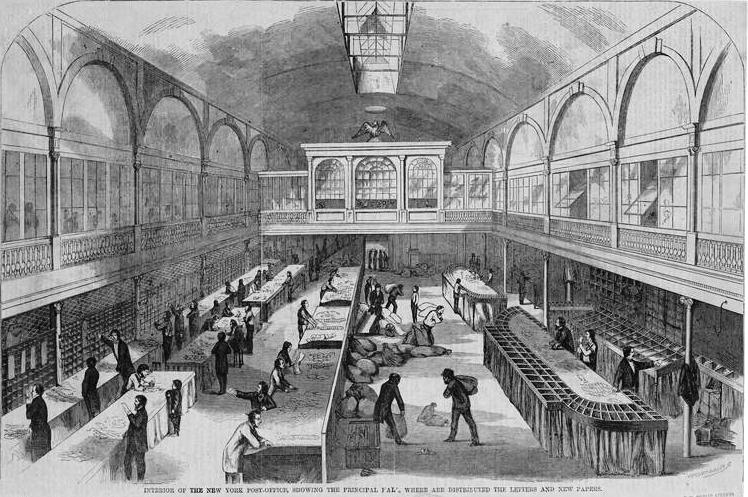
I have been working on my garden for much of the last month. This is an all-consuming task, but today I had the opportunity to find an old article that I wrote on the origin of data centers, “Preliminary Findings Toward an Architectural History of the Network,” New Geographies 07 (2015).
In this essay, I explore the architectural history of networks, focusing on the typology of data centers and its historical emergence. The network, despite receiving critical attention since the Internet’s proliferation, has been largely overlooked from an architectural perspective.
I argue that understanding the data center as a building type is essential, as well as understanding that it encompasses various architectural manifestations ranging from repurposed buildings to purpose-built structures. I trace the origins of the data center to the post office, which developed in the United States in the mid-nineteenth century. I examine the link between data centers and territory, emphasizing the role of the mail system in the political development of the nation.
The expansion of postal routes, the implementation of a hub-and-spoke system, and the architectural form of post offices are detailed, highlighting the network’s infancy and its historical emergence in typological terms. The essay continues with an examination of the introduction of home delivery and the development of the telegraph system. I analyze the growth of telegraphy, its alliance with the media, and concerns about monopolies. Overall, this research provides a comprehensive examination of the architectural history of networks, shedding light on the typological, geographical, and technological aspects of networks. My goal was to provide insights into the historical significance and contemporary relevance of data centers, thereby contributing to a broader understanding of the material and geographic conditions shaped by the constraints of the physical world.
I am going to Vilnius next week and this reminds me of my last visit… in which I told myself that it’s critical to get my unpublished 2019 essay on Valdas Ozarkinskas, the most brilliant architect I ever met out there. Well, here it is: Stalker Architecture: Design and (Private) Ideology.
Imagery is the stumbling block for this essay, as I don’t have access to an archive, so I have mainly borrowed images from other sites. I’m doing this under the principle of academic fair use since all I want to do is get Valdas’s work exposure outside Lithuania, if you own any of them and want me to take them down, by all means, get in touch!
I moved Varnelis.net to Kinsta yesterday, widely seen as the best WordPress host around. I also updated the site theme to GeneratePress which I first used at the Native Plant Society of New Jersey where I am the head of advocacy and, to help out, brought the Web site to WordPress. The site struggled after I had serious security issues earlier in the year. Not only was that a crummy experience for you, the backend that I write posts with glitched constantly and it was frustrating for me to enter new content. The new site is a delight for me and, I hope, is interesting for you as well. The theme is ultimately based on Indexhibit, which was admirably minimalist in a way a Lithuanian artist could love but never worked for me as a content management system.
I have lost count of how many times I have said that I will be posting more on this site, so I won’t make promises I can’t keep, but at least the site won’t be an excuse anymore. So what about blogs? Aren’t they dead? Archinect’s blog, aggregat:456, archidose, ballardian, javierist, m.ammoth.us, markasaurus, sit down man you’re a bloody tragedy, strange harvest, subtopia all gone, lgnlgn a record of an aborted restart ten years back. Even bldgblog barely posts more than I do now. But I refuse to go. Loos titled his first collection of essays “Spoken into the Void.” Being untimely may be the strongest position of all.
Now, there’s not that much to say about architecture anymore, but that’s ok. Times change. Architecture is at its lowest point in my lifetime. There is no excitement. When is the last new building that interested you, I ask my friends? Nobody knows. Maybe the Casa da Música, one said. That’s like saying the Ford Foundation building was the last great building in 1981. Not one great building on this list of top ten buildings in the 2010s, not even one good building. The scandal isn’t that there is a scandal, the scandal is that nobody cares and nobody talks about it. Conceptual architecture is dead in the water. Architecture fiction was the last burst of a shooting star deep in the atmosphere before it disappeared. In fairness, I don’t know if either AUDC or the Netlab will do anything again, although I continue my own work in earnest (more on that work another day).
But there is plenty to talk about; we can talk about late network culture and the sorry state it has brought us to, the failure of networked publics. we can talk about art, and we can talk about the environment and the importance of native plants in the landscape. We can even talk about architecture since art forms that seem to be things of the past have an uncanny way of coming back to life. I have a lot to say about these things and, with the end of (native) planting season upon me this week, I may be doing just that. But I won’t be doing that on social media. Sure, you may see these posts on Facebook or Twitter, but I’m not really there much anymore. After logging off Facebook for a year, I found I didn’t want to use it anymore. Facebook doesn’t create a feeling of belonging, it creates anxiety and depression. No wonder young people don’t want to use it anymore. Facebook’s troubles are deepening and it’s ridiculous foray into virtual reality will, we all hope cause its utter demise. Twitter stayed relevant for longer, but I am noticing many fewer posts from my friends there these days. Growth at both of these platforms has ceased, even reversed. So Elon Musk is buying Twitter. That’s the equivalent of buying a new gasoline car today, a dying platform terrible for the environment. Twitter is dying. If Elon brings back the seditious, short-fingered vulgarian now suffering through mid-stage dementia, it will just bring end Twitter to an end and wipe out his ludicrous $44 billion investment. Young people increasingly hate these platforms, regardless of what money-chasing analysts want you to believe. Yes, there are podcasts. I love them, but I worry about the effect of constant voices in my head, perhaps because I read Julian Jaynes many decades ago. There are Medium and Substack, but the endless demand for money is tiresome. You may read this on Substack. Great. But you don’t have to. Read it here instead.
The social media era is over. Long live the blog. My posts may be few and far between, they may be late, they may be bad, you may not read them but they are still something I own. I can say what I want, unbeholden to anyone else and I’m not going anywhere anytime soon.
According to conventional chronological schemas, 2020—not 2019—is the last year of the 2010s.* This is convenient since, as I pointed out in last year’s premature review of the last decade, the 2010s were “the decade of shit” and 2021 is a stinking pile of shit. The worst decade since World War II ended with the worst year since 1945.
My “year in review” posts are usually almost as late as my taxes and when I finished last year’s post on February 12, we were all well aware that COVID was out there. Now, no question that I missed the severity of the pandemic back then, but I was on the money about its psychic effects. For all of the horror of COVID, it isn’t horrible enough. COVID is banal. Instead of bleeding out through all of our orifices as with Ebola, COVID is “a bad case of the flu” that leaves people dead or with debilitating cardiovascular and neurological ailments. But how different is my diagnosis, really, from what happened?
Now sure, this year [2020] we’ve already had firestorms the size of Austria ravaging Australia, a rain of rockets in Baghdad, Ukrainian jetliners getting shot out of the sky, a deadly pandemic in China caused by people eating creatures that they really shouldn’t, and the failure of the Senate to uphold the rule of law, but the banality of it all is crushing. While the Dark Mountain set drinks wine around a campfire, gets henna tattoos, and sings along to songs about the end of nature, for the rest of us, it’s just an exhausting, daily slog through the unrelentingly alarming headlines.
COVID brought us yet more crushing banality. The Idiot Tyrant is gone, but we are trying his impeachment yet again. Everything changes, but nothing changes. We were all the Dark Mountain set this year, sitting around our campfires, singing songs about the End. It was another atemporal slog, one day bleeding into another, every day a Sunday in a country where everything is closed on Sundays and there is nothing to do, every day stranger and more disconnected than the last, something captured in comedienne Julie Nolke’s series of videos entitled “Explaining the Pandemic to My Past Self.”
Amidst the disconnection, the Jackpot—or William Gibson’s term for a slow-motion apocalypse—cranked up a couple of notches. Just surviving the year was an accomplishment. The balance of life has been thoroughly disrupted and that disruption isn’t going away any time soon. It’s not just COVID: we now feel certain that there will be more pandemics, more massive wildfires, and more superstorms in our future. The Earth isn’t dying (sorry, climate doomers), but there will be huge losses of species worldwide, human population decline is well underway in advanced societies (the US is finally on the bandwagon here), and massive deaths will take place across the planet until the population comes back to a sustainable level decades from now.
But the premise of the Jackpot is that it isn’t a final apocalypse: there will be another side. In his Twitter feed (@GreatDismal), even Gibson focuses on the horrific and unjust nature of the Jackpot, but there will be winners, selected on the basis of wealth and sheer dumb luck. What might this say about the US election and the fact that 46% of Americans voted for a cretin? Now, there is nothing particularly new about melding Tourette’s and dementia into a public speaking style, there are plenty of lunatics sitting on their porches screaming obscenities at their lawn ornaments. Everybody knows that Uncle Scam’s persona as a billionaire—or rather the King of Debt (his own term!)—is an act. The man with the golden toilet is not a successful businessman. He is weak, a loser who can’t stay married or stay out of bankruptcy court. Four years of misrule ended in abject failure: defeat in both electoral and popular votes, being banned from social media and, with his businesses failing, being forced out of office in shame to face an unprecedented second impeachment, an array of civil litigation as well as criminal indictments for fraud, tax evasion, incitement to riot, and rape. But this—not a misguided notion of him as a success—is the real point of his appeal. The short-fingered vulgarian is a life-long loser, a reverse Midas whose every touch turn gold to lead. But in the face of the Gibsonian Jackpot, his appeal was not as a stupid version of Homer Simpson, grabbing whatever scraps he can and, when that failed, LARPing as President, destabilizing society, and just blowing everything up.
LARPing was big in 2020, which saw the attempted kidnapping of Michigan Governor Gretchen Witmer by wingnut idiots, various insane protests by COVID deniers, the attempted coup of the Capitol Insurrection, and the riots developing after the Black Lives Matter protests. BLM was the standout among these, not only a good, just cause, but also because the majority of the protests themselves were peaceful—such as the one in our town of Montclair, New Jersey. None of that was LARPing, but the riots that accompanied it were. For the most part, this was less people with genuine greivances and more Proud Boys, Boogaloos, anarchists, and grifters who came in to loot and burn whatever they could down. Although there were kooky moments on the Left like the Capital Hill Automonous Zone, Antifa, for however much it exists, didn’t do much, certainly proving to be far less trouble than white supermacist-infiltrated police forces in paramilitary gear. Still, the widely-vaunted second Civil War never came about and the arteriosclerotic LARPers on the Right limped off the field in defeat after their they got a spanking at the January putsch.
A number of observers at both the Capitol Insurrection and CHAZ —including some of the idiots who took part in it—noted that these events felt much like a game, specifically an Alternate Reality Game (ARG). In a typical ARG, players look for clues both online—think of the QAnon drops, the Trumpentweets, or the disinformation dished out by the skells at 4chan, 8chan, and so on—as well as out in the world. Jon Lebkowsky, in a post at the Well’s State of the World and Clive Thompson over at Wired compare QAnon to an ARG. Indeed, gaming is taking the place of religion (whichever grifter figures out how to meld this with Jesus and his pet dinosaurs will get very rich indeed), with the false promise that playing the game and winning will deliver one to the other side of the Jackpot. Somewhere, I read that when asked what he would do differently if he had made Blade Runner a decade later, Ridley Scott replied that he would be able to skip the elaborate sets and just point the camera down the streets of 1990s Los Angeles. Today, the same could be said for the Hunger Games today.
But not everything was LARPing. If Cheeto Jesus is an icon for LARPing losers, Biden was elected on the premise of staving off the Jackpot by returning adults to the White House. This is not a bad thing, we might as well try. Still, from the perspective of Jackpot culture, the most interesting political development of the year was the candidacy of Andrew Yang whose cheery advocacy of Universal Basic Income (aka the Freedom Dividend) masked the dark, Jackpot-like nature of his predictions. Let’s quote Yang’s campaign site on this: “In the next 12 years, 1 out of 3 American workers are at risk of losing their jobs to new technologies—and unlike with previous waves of automation, this time new jobs will not appear quickly enough in large enough numbers to make up for it.” No matter how friendly Yang’s delivery, there is a grim realism to his politics, an acceptance that things will never be better for a massive sector of the population. Certainly some individuals will find ways to use their $1,000 a month freedom dividend as a subsidy to do something new and amazing, but 95% will not. Rather, they will form a new and permanent underclass as they fade into extinction. Again, the point of Yang’s candidacy isn’t the cheerleading for math and STEM, it’s the frank acknowledgement that the Jackpot is already here.
On the other hand, toward the end of the year, Tyler Cowen suggested that we might be nearing the end of the Great Stagnation (he is, of course, the author of an influential pamphlet on the topic) and you can find a good summary of the thinking, pro and con by Cowen’s student Eli Dourado here. In this view, advances such as the mRNA vaccine, the spread of electric, somewhat self-driving vehicles, the pandemic-induced rise of remote work, and huge drop in the cost of spaceflight are changing things radically and could lead to a real rise in Total Factor Productivity from the low level it has been stuck at since 2005. Is this a sign of the end of the Jackpot? Unlikely. That won’t come until a series of more massive technological breaks, probably (but not necessarily) involving breakthroughs in health (the end of cancer, heart disease, and dementia), the reversal of climate change, working nanotechnology, and artificial general intelligence. But still, there are signs that early inflection points are at hand.
Personally, we experienced one of these inflection points when we replaced our aging (and aged) BMWs with Teslas. I wound up getting a used Tesla Model S last January and then immediately turned around and ordered a brand new Model Y that we received in June. No more trip to the gas station, and while “Full-self driving” is both expensive and nowhere near fully self driving, it is a big change. Longer road trips—which under the pandemic have been to nurseries on either side of the Pennsylvania border to buy native plants—have become much easier, even if I still have to keep my hands on the wheel and fiddle with it constantly to prevent self-driving from disengaging. But harping on too much about the incomplete nature of self-driving is poor sport: in the last year, Tesla added stop light recognition to self-driving and a new update in beta promises to make city streets fully navigable. Less than a decade ago, self driving was only a theoretical project. Now I use it for 90% of my highway driving. That’s a sizable revolution right there. Also, the all-electric and connected nature of these cars makes getting takeout and sitting in climate-controlled comfort in my vehicle when on the road a delight. Electric vehicles were a big success this year and in our neighborhood which is a bellwether for the adoption of future technology (when I saw iPhones replace Blackberries on the bus and train into the city, I bought a bit of Apple stock and made a small fortune) and Teslas have replaced BMWs as the most common vehicle in driveways.
Back to the pandemic, which accelerated a sizable shift in habitation patterns. Throughout the summer, there was a lot of nonsense from neoliberal journalists and urban boosters about how cities are going to come back booming, but with more bike lanes, wider sidewalks, less traffic, and more awesome tactical urbanist projects to appeal to millennials. Lately, however, those voices have fallen silent and with good reason. In this suburb the commuter train platforms are still bare in the mornings and the bus into the city, once packed to standing room only levels every evening, hasn’t run in five months. A friend who works in commercial real estate says that occupancy in New York City offices is at 15% of pre-pandemic levels. Business air travel is still off a cliff. Remote work isn’t ideal for everyone and every job, but neither was going into the office. For sure, the dystopian open offices, co-working spaces, and offices as “fun” zones are done and finished. People are renovating their houses, or upsizing, to better live in a post-pandemic world of remote work. Another friend who works for a large ad agency told me that they did not renew their lease for office space and do not plan to ever go back to in person work, at least for the vast majority of the staff. When employees gain over two hours a day from not commuting and corporations save vast fortunes on rent, remote work seems a lot more appealing. Retail sales here and in the surrounding towns have gone through the roof, just as they have in many suburbs.
But it isn’t just suburbia that has prospered at the expense of the city, exurbia has returned too. Way back in 1955, Auguste Comte Spectorsky identified a growing American cultural class that he dubbed “the exurbanites” made up of “symbol manipulators” such as advertisers, musicians, artists, and other members of what we today call the creative class. Spectorsky observed that many of these individuals eventually tended to drift back to the city. This time may be different. After two decades in the city, the creative class is turning to places outside the city with attractive older houses and midcentury modern properties, walkable neighborhoods (virtually all of Montclair, for example, has sidewalks), good schools (which generally mean high property taxes but are an indicator for a smarter, engaged populace), amenities like parks and places to hike, decent bandwidth, as well as independent restaurants, shops, and cultural attractions. There will always be variations in taste: some people really do want to eat at Cheesecake Factory and live in a Toll Brothers McMansion, but these will appeal to relatively few of the people fleeing cities at this point. Thus, the Hudson Valley—full of older, more interesting architecture, great natural resources and quirky towns—is booming. I predict some reversion to toward the mean after the pandemic ends and some of the people who fled to the country realize they aren’t suited to a place without Soulcycle, but this will be only a partial and temporary reversion.
I predict that even after the pandemic ends, there will be a greater interest in self-sufficiency among young people who move to suburbia and exurbia. Manicured laws will be less important than vegetable gardens. Homesteading, permaculture, and a drive back to the land not seen since the 1960s are under way. It would be a very good thing if the next generation was more in touch with their land and less prone to hiring “landscapers” who treat properties as sites subject to industrial interventions such as chemical fertilizer for lawns, a phalanx of gas-powered lawn mowers and leaf blowers to remove any stray biological matter.
As far as cities go, the pandemic is triggering a necessary contraction. The massive annihilation of real estate value it has caused should go a long way to undo the foolish notion that urban real estate is always a great investment. It’s not, just ask anyone who bought a house in Detroit in 1965. Real estate in first and second tier global cities has become wildly expensive, disconnected from the underlying fundamentals. When individuals are paying rents that absorb over 30% of their salaries to investor-owners who are not covering their mortgage with those rents, something is very wrong. This broken system has been able to function due to the perceived hedonic value of restaurants, bars, and cultural events, but these things too have been failing over recent years. Long prior to the pandemic, the cost of rent decimated independently-owned restaurants and retailers, with the latter also hurt by on-line shopping. The golden age of dining out (if it really was the golden age… I would say that better food could have been had in other, less copycat eras) was already declared over in 2019. “High-rent blight,” in which entire streets’ worth of storefronts were empty due to ludicrous rents, has been common for some time now. Tourists made up more and more of the street crowds while loss-leader flagship stores for chains like Nike and Victoria’s Secret replaced local businesses. With the hedonic argument for staying in the city rapidly disappearing, it was only a matter of time before individuals began departing and, in New York, population had begun to drop by 2018 (see more on all of this in Kevin Baker’s piece for the Atlantic, “Affluence Killed New York, Not the Pandemic”). Perversely, this is a good thing as it will likely lead to a bust in commercial real estate prices and a decline in unoccupied or AirBNB’d apartments, thus making global cities like New York places that have potential again. Moreover, many second tier cities such as St. Louis, Kansas City, and Cleveland are experiencing new growth as individuals able to work remotely are looking for places that are less expensive—and thus have more potential—than New York or San Francisco.
These shifts are huge and for the better. As I tried to tell my colleagues at the university, there is no housing crisis, at least not in the US and Europe, there is only an appearance of one because of the uneven distribution of housing: a glut in some areas, a shortfall in others. The pandemic has likely undone this a bit. Of course, places that are too politically Red, too full of chains, too full of copycat McMansions are unlikely to come back anytime soon, if ever. The Jackpot continues.
Still, I’m observing a perversely rosy future for the urban (and suburban and exurban) environment is the Biden administration’s interest in infrastructure. Back in 2008, I shocked design critics when I stated that there would be no progress in infrastructure for the foreseeable future. “But, Obama,” they complained. “But, Obama,” I clapped back, “just appointed Larry Summers as his chief economic advisor and Summers will bail out the banks, not fund infrastructure.” I expect the opposite from Biden who has adopted a “nothing left to lose” position as purportedly one-term President, is a devotee of train travel and is eager to make great progress on climate change. Appointing Pete Buttigieg, one of his two smartest opponents in the primary (the other being Andrew Yang, of course), to Secretary of Transportation is a key move. This will be Buttigieg’s opportunity to prove himself on the national stage and he will fight hard to do that, just as Biden expects. Expect more electrification across the board and, I suspect, more advances with self-driving vehicles. Although certain measures—such as, in the New York City area alone, the Gateway Tunnel between New Jersey and New York, now delayed over a decade thanks to Chris Christie and Donald Trump’s vindictiveness against commuter communities that would not vote for them and the reconstruction of Port Authority Bus Terminal—will help cities, again, I predict more emphasis on decentralization and activity outside the city.
All this may have salutary cultural implications. The global city is played out. Little of interest happens in New York, San Francisco, London, Paris, or Barcelona. These cities are too expensive for the sort of experimentation that made them great cultural centers and the diffusive nature of the Internet, capitalism, and overtourism have made them all the same. Residents of cities that have been victims of overtourism have seen this as an opportunity to reset, while the physical isolation of cities is going to increase reliance on local institutions. With some luck, all this leads to a new underground, with greater difference creating greater diversity and potential. Of fashion, Bruce Sterling writes, “Fashion will re-appear, and some new style will dominate the 2020s, but the longer it takes to emerge from its morgue-like shadow, the more radically different it will look.” The same could be true of all culture. Globalization was an incredibly powerful force but has been played out. I don’t agree with the protectionist instincts of the Trumpenproles but today culture’s hope is to thrive on the basis of the difference between places and cultures, not on greater sameness. Architecture has been very slow to react to all of this, in part because many intelligent young people have drifted into other fields, like startups, but I am optimistic that we might soon get past the ubiquitous white-painted brick walls and wood common table (the architecture of the least effort possible, to match fashion and food driven by the least effort possible), the tired old Bilbao-effect, and quirky development pseudo-modernism.
So much optimism on my part! Even I am shocked that I am so positive. But why not? The end to this exhausted first phase of network culture is overdue. Time for a new decade, at last.
*The reason for this is that there is no Year Zero. 31 December 1BC is followed by 1 January 1AD.
I will be talking about the work of Lithuanian-born artist Aleksandra Kasuba at the University of Limerick School of Architecture on Wednesday, 24 February at 5pm. You can see her work at Kasubaworks.
Lithuanian-born artist Aleksandra Kasuba is known for her large scale works in brick, marble and granite, and most notably for innovative environments of tensile fabrics. She is credited with “creating several families of closed system shapes of unbelievable richness and complexity.” In the field of tensile fabric structures, according to Frei Otto, her work “stands out as a strong personal vision […] The results of her investigation are among the most extraordinary to have emerged in years […] Forms derived from complex geometries display a mature sense of tension dynamics.”
Yesterday, I discussed Bowie and his prescient understanding of network culture. But what of Bowie and architecture? Shouldn't I say something about that?
Generally speaking, architects have been unwilling or unable to learn Bowie's lessons, stuck in an idea of branding borrowed from business books from the discount table at Barnes and Noble and history borrowed from art historians seeking the hand of the master. Many of the architects who would be the easiest to compare to Bowie in the way their were able to put on different masks—Charles and Ray Eames, Erik Gunnar Asplund, and 1950s Corbusier—preceeded him.
So what of Johnson and Bowie? Of course there is a similarity in that both had a flirtation with fascism in their youth, but in Bowie's case there is no evidence of any actual political involvement. Bowie's coked-up ramblings were meant to scandalize and were dropped soon enough. Johnson's political activities lasted the greater part of a decade and he never rejected them as bluntly as Bowie did in his derision of fascists in Scary Monsters or criticism of imperialism in Let's Dance. But the issue at hand would be the ability to transform. Johnson likely learned from Bowie's shape shifting as he returned to prominence to the 1970s, but in fairness, Johnson was more like an aging crooner and if, like Bowie, he was always a provacateur, he lacked Bowie's technical and formal instinct. With the exception of the AT&T Building, none of his works after his return in the 1970s were "hits."
Then there's Koolhaas. Jeffrey Kipnis mentions Bowie in a reference meant to contextualize Rem Koolhaas, Elia Zenghelis, Madelon Vriesendorp, and Zoe Zenghelis's Exodus or the Voluntary Prisonerso of Architecture: "London's Architectural Association 1970-72: a school awash in sex, drugs, and rock and roll. David Bowie hanging at the bar. …" But this is hardly history, rather it's name dropping meant to build up a myth. Even so, it deserves mention. At one point Koolhaas did seem like Bowie. The early 1970s work followed by Delirious New York, a bad period of terrible work in the 1980s, then a comeback in the 1990s with works like the library at Jussieu, the TGB, the Kunsthal, and Zeebrugge. For a time, it seemed like Koolhaas might wear many masks, but by the early 2000s, his career became less like Bowie's and more like Johnson's. Where Bowie repeatedly put his career at risk to pursue his artistic vision, Koolhaas has been in a nihilist death-spiral for 15 years, out to produce more junkspace than anyone else. No way would Bowie have ever put out a clunky salute to authoritarianism like the CCTV building.
I don't feel comfortable adding myself to this mix, but as I've already publically stated that I've been influenced by Bowie, I suppose I have to. Simply enough, early on in my education I realized that architecture—as conventionally practiced—was too slow and too tied to capital to keep pace with my ideas. Influenced a bit too much by Manfredo Tafuri on the one hand and reluctant to call myself an artist when my father had that market cornered pretty well, I began as a historian of architecture. After about four or five years, I set out to look at urban infrastructure and work with the Center of Land Use Interpretation. Toward the end of this period, I began to work with Robert Sumrell to create AUDC and our Blue Monday project, a book that we consciously conceived of as a sort of historical-philosphical LP.* From 2008 to 2015, I was engaged with a number of participatory projects under the guise of the Netlab at Columbia, such as the New City Reader. Over the last year, with the labs experiment at Columbia's GSAPP—which one day will be seen as a formative moment for architectural education—drawing to a close, I've rethought the Netlab's role as an independent entity and shifted the focus of my attention more toward Europe and less toward the US. There will be new work, which I hope you will find as compelling as I do from Leigha Dennis and myself, operating as the Netlab on exhibit in from early June to August at the Šiuolaikinio Meno Centras/Contemporary Art Centre in Vilnius, Lithuania. The focus of my contribution to this exhibit will be large, physical, constructed and something that I think hasn't been seen yet. I'm not suggesting that I'm living up to what Bowie did by any means. But rather, that his ability to transform himself is something that has remained intriguing to me over the years.
As Simon Critchley points out in his book on Bowie, this re-invention was not a lack of authenticity, but rather an understanding that authencity lies at a deeper level than style. It's unfortunate that in instead of being taught to experiment, architecture students are urgerd to relentlessly hone a particular look and even hired on that basis: being able to sum yourself up in a one-liner is more important than depth and the ability to come back and reinvent yoursef. The latter is what network culture demands and the inability of architects to do so is quite boring, isn't it? *Which is not to say that there won't be future AUDC books. Far from it…
Valdas Ozarinskas passed away yesterday and a bad year became much worse. I had heard he was not well when I was in Vilnius last week and I feel awful that I didn't make an effort to see him.
Valdas was a brilliant architect. For years he practiced at the Šiuolaikinio Meno Centras/Contemporary Art Center in Vilnius, Lithuania, creating exhibitions that were stunning. Minimal but aggressive, Valdas's works were comparable in force only to the very earliest moment of minimalist art, before it became a style, an architectural equivalent of industrial music (I mean from the days of Throbbing Gristle, not the drum-machine driven works of the 90s). Valdas publically eschewed ideology but could probe theoretical questions as deeply as any architect I know. We had many conversations whenever I visited Lithuania, generally about the problem of the individual in a post-industrial society. Had he spoken English and had he written his thoughts down others would have understood how deep a thinker we have lost. The loss, to put it in a Lithuanian context, is comparable to the loss of George Maciunas 35 years ago, another figure of similar force, but who I only had a chance to meet once. Their minds were not dissimilar: both Sloterdijkian kynics in the best sense.
He made many projects, but I will only reflect on one here. Valdas often collaborated with Audrius Bučas and together they produced Black Pillow, which was shown at the ŠMC in 2011 and subsequently at the Liverpool Biennial. The show'sweb site wrote that given its exhibition at the peak of the economic crisis in Lithuania,
The two architects’ formalist idea was initially supposed to appeal exclusively to the limits of the viewer’s phenomenological experiences. However, it quickly got wrapped in various stories and interpretations due to its unusually large dimensions, menacing black colour and the moods that prevailed in Lithuania at the very peak of the economic crisis. Black Pillow took a symbolic shape and dimension accumulating all the possible personal and collective failures of our lives.
From our discussions in the gallery next to the black pillow it was clear that Valdas understood and intended such a symbolic dimension from the start. Or more specifically, he intended—as he often did—to give us a neutral but cathetic object that we could project onto as we wished. Never melancholy, Valdas was always relentlessly positive even about the bleakest of conditions, albeit often astounded at the stupidity of our world.
Alain Badiou's 12th thesis on contemporary art reads "Non-imperial art must be as rigorous as a mathematical demonstration, as surprising as an ambush in the night, and as elevated as a star." Nothing could describe Valdas's work better. One night over beers at the ŠMC cafe, its Lithuanian Soviet modernism itself brilliantly reconstructed by Valdas, I read the theses to him, translating them into my broken Lithuanian as best I could and we shared our analysis of the theses.
Even last week Valdas was putting together a final show, at the Antanas Moncys House in Palanga. That we have lost such a mind only proves how stupid our world is. To talk to Valdas was to hear the Lithuanian word "siaubas" or "horror/terror" over and over. That was the madness of this place we inhabit, a world in which we battle against zombie bureaucrats and power-mad psychopaths, where goodness is rarely rewarded but idiocy is. To remember him, what can we do but we keep marching forward, one foot in front of the other and say, anything is possible?
It's my great honor to be speaking at Taliesin West today, 27 February at 7pm in Scottsdale, Arizona. My lecture will be about network culture, my work with the Netlab, and my kids' constructions in Minecraft).
With the end of the year approaching, I might as well begin my reflections with yet another rote lament for why I don't post enough anymore. Blogging is dead for many and has been dead now for about as long as it thrived. Somehow, I resolve, I'll turn back to blogging one day, but other things come first, like my kids, my project at MoMA, various projects at the Netlab, teaching, articles that I have neglected too long, writing my book, working on the restoration of my house and so on.
But every now and then it turn back to the Web, if not to blogging then to working on the infrastructure beneath my stable of Web sites. In this case, this morning I took the Networked Publics site and converted it to from a live Drupal installation to a static site. Networked Publics ceased to be live years ago as it was the record of a year-long workshop that took place from fall 2005 to fall 2006 and the book that came out of the workshop was published in 2008. Besides me the last log at Networked Publics comes from my late colleague and friend Anne Friedberg some six years, twenty-four weeks ago. I find it sad that the group we formed doesn't stay together virtually, but such, I suppose, is the nature of scholarly collaborations involving individuals from radically disparate fields. Still, as a historian, the record of a year spent by a team of scholars investigating a topic seems worth paying a few dollars to keep registered so I spent a couple of hours to ensure the site wouldn't be tied to an aging Drupal 6 infrastructure.
Looking back at the low-fi Web 2.0 site and the low-fi videos on it, it already seems like ancient history. But this was the state of the art not 15 or 20 years ago but rather a mere eight years ago. The trends that the Networked Publics group identified—the rise of DIY media in particular—are now not the province of nerds and geeks but rather part of our everyday lives. It's stunning to think back and remember showing the group the first video iPod that I had purchased soon after its release that year. Such, I suppose is the process of aging in the technological future. One gauges oneself as much by the personal milestones one experiences as by the tech one leaves behind.
For me, development on Drupal has become something to leave behind as well. Last year I concluded my development of Docomomo-us.org, which I had transitioned from outdated custom cgi code to Drupal back in 2006, by having Jochen Hartmann take over as web developer and earlier this year I replaced the Drupal sites for both AUDC and the Netlab with sites driven by Indexhibit. This process of steadily whittling down my Drupal sites means that this remains the only one I have left (minus the seriously neglected Lair of the Chrome Peacock).
But this isn't a mere status update regard the infrastructure of these sites. Changes in infrastructure, as my readers should know, are never innocent, but rather embody ideological and social changes. When I first came to Drupal back in 2005, I was encouraged by the ease of extending the system and its Open Source development. For a time I was active in the community at Drupal. Not being much of a coder anymore, I asked questions, gave suggestions, and helped out with some problems people had on the forums, but it became clear to me that most people on Drupal's communty site fell into three categories. Those just starting out, those trying to help out as they could (and usually fleeing when they felt overwhelmed… this typically happened after they had submitted a new module or theme), and those who were either dedicated hobbyists or worked with Drupal for a living. Not being part of the latter two, I wound up retreating.
As a designer, I had this foolish idea that my site should look the way I want it to look so I spent a ridiculous amount of time tweaking these sites by building themes for them and outfitting them with extensions called "modules." Unfortunately in an effort to optimize its code base, the developers of Drupal have adopted a mantra which states that "the drop is always moving" which simply means that Drupal will actively break any themes and modules during each major point release. The result is that I found myself needing a month of down time to upgrade my sites from Drupal 5 to Drupal 6. For a scholar to do this is preposterously difficult. For a scholar with kids to do this is virtually impossible.
Drupal 7 came out a while back, but lacking any compelling features, I chose not to upgrade. After all, a month of down time just to get back to where I was is hardly attractive. Now Drupal 8 promises adaptive themes that will appropriately react to the mobile platforms that increasingly drive Web traffic so I am likely to go to it, but even though new development was frozen in the system a year ago, it seems far from prime time. I spent more than half an hour today looking for a release date for the first beta and couldn't find anything but long-outdated information. If this site is to be believed, there are more critical bugs in Drupal 8 today than a year ago.
Therein lies the trouble with Drupal and modern coding: immense complexity (see my comments on complexity at Triple Canopy). Projects of this size become impossible to manage, impossible to code, and impossible for users to work with. My front page is aging, an artifact from an era in which laptops commonly had screens with a resolution of 1024 X 768 not 1920 X 1200 (as my current one does) but to redo when it will only break again soon seems ludicrous. Perhaps I'll use another system like WordPress to run this site or maybe I'll pickle it and fork off to another platform. Any of this is possible, but I'll hardly recommend Drupal to anyone again or do anything but build the most minimal theme I can for it.
Beyond a stern caution about the complexity that Open Source projects can generate and that can choke them, as Drupal has been choked, for all of the technological maturation that we've seen over the years since Networked Publics, the one thing that we've drifted away from is Web presence. If the static Web marked the 1990s, Web 2.0's dynamic Web sites dominated the time in which we wrote Networked Publics. Bringing varnelis.net back to life with Drupal in 2005, I envisioned it as part of an interlinked ecology of sites, both local (AUDC, DoCoMoMo-US, the Netlab, etc.) but also global, interlinking to other sites through RSS feeds and commenting systems. This hasn't happened, to this site or any other. Web 2.0's strongest links such as social bookmarking (repeated problems with Delicious at the hands of Yahoo! and AVOS and the meltdown at ma.gnolia) and RSS suffered a similar fate after Google Reader shut down this summer. As Open Source withers when it becomes over-complex, struggling corporations like Yahoo! and Google undo matters in their binge and purge cycles, buying up whatever they can in hopes of monetizing the Web and then wiping out communities when they turn out to be too hard to profit from.
Instead of the open Web then, we have apps and the privatized, Balkanized world they promise. It's hard not to be gloomy about this, hard to find a happy face to put on all this. Perhaps that is my wont, but sometimes there isn't one. The problems of cooperation, collaboration, and democratic decision-making remain the thorniest of problems for Networked Publics.
It’s my absolute delight to finally be able to announce that the Network Architecture Lab will be collaborating with MAPOffice in the 2014 “Uneven Growth” exhibition at New York’s Museum of Modern Art.
Pedro Gadanho, curator for contemporary architecture at MoMA is curating the exhibit which runs from November 22, 2014 to May 10, 2015. The show will be launched on October 26 of 2013 with presentations by the different teams at MoMA’s PS 1. More details here.
It’s an incredible opportunity for myself and the Netlab, not only because of the importance of the venue and Pedro’s brilliance as a curator, but also because of the subject matter. It’s going to be a great journey!
Text from the press release follows:
In 2030, the world’s population will be a staggering eight billion people. Of these, two-thirds will live in cities. Most will be poor. With limited resources, this uneven growth will be one of the greatest challenges faced by societies across the globe. Over the next years, city authorities, urban planners and designers, economists, and many others will have to join forces to avoid major social and economical catastrophes, working together to ensure these expanding megacities will remain habitable.
To engage this international debate, Uneven Growth brings together six interdisciplinary teams of researchers and practitioners to examine new architectural possibilities for six global metropolises: Hong Kong, Istanbul, Lagos, Mumbai, New York, and Rio de Janeiro. Following on the same model of the MoMA exhibitions Rising Currents and Foreclosed, each team will develop proposals for a specific city in a series of workshops that occur over the course of a 14-month initiative.
Uneven Growth seeks to challenge current assumptions about the relationships between formal and informal, bottom-up and top-down urban development, and to address potential changes in the roles architects and urban designers might assume in the evolution of cities. The resulting proposals, which will be presented at MoMA in November 2014, will consider how emergent forms of tactical urbanism can respond to alterations in the nature of public space, housing, mobility, spatial justice, environmental conditions, and other major issues in near-future urban contexts.
Urban Case Study Teams:
New York: Situ Studio, New York, and Cohabitation Strategies (CohStra), Rotterdam
Rio de Janeiro: RUA Arquitetos, Rio de Janeiro, and MAS Urban Design ETH, Zurich
Mumbai: URBZ, Mumbai, and Pop Lab, Massachusetts Institute of Technology (MIT), Cambridge
Lagos: NLÉ Architects, Lagos, and Inteligencias Colectivas, Madrid
Hong Kong: MAP Office, Hong Kong, and Network Architecture Lab, Columbia University, New York
Istanbul: Superpool, Istanbul, and Atelier d’Architecture Autogérée, Paris
Uneven Growth: Tactical Urbanisms for Expanding Megacities is organized by The Museum of Modern Art, New York, in collaboration with the Museum of Applied Arts (MAK), Vienna.
This is the third exhibition in the series Issues in Contemporary Architecture, supported by Andre Singer.
The accompanying workshops at MoMA PS1 are made possible by MoMA’s Wallis Annenberg Fund for Innovation in Contemporary Art through the Annenberg Foundation.