


2025-in-review

It’s strange to measure every year against a concept developed by a science fiction writer, but William Gibson’s line “The future is already here—it’s just not evenly distributed”1. has been my north star for my recent year-in-review essays. Gibson meant that the future was unevenly distributed by class: the wealthy receive high-tech healthcare while the world’s poorest live in squalor—though one might ask which of these is really our future. Yet the quote has been repeatedly misread as a claim about time andspace: that the future arrives somewhere first, perhaps unseen, while the rest of the world catches up. But this misreading is more productive than Gibson’s intent. Gibson’s critique of inequality is fair enough, but we all know this, decry it, and go on about our business. The misreading, on the other hand, is a theory of historical change.

With the release of ChatGPT in late 2022, a temporal rift opened, shattering the post-Covidean present. But many tried the early tools, encountered hallucinations, read articles about slop and imminent environmental ruin, and reasonably concluded there was nothing to see. By 2025, a cursory examination of news in AI would have assured them that AI had proved a bust. OpenAI’s long-awaited updates disappointed, and the company flailed, turning to social media with Sora, a TikTok clone for AI. Meta seemed to abandon its efforts to create a competitive AI and instead turned to content generation for Instagram and Facebook, something nobody on earth wanted. Talk of a bubble started among Wall Street pundits. The hype-to-disappointment cycle is familiar, and the dismissals were not unreasonable.

But again, the future isn’t evenly distributed, and if you don’t know where to look, you would be excused for believing it’s all hype. Looking past such failures, 2025 was actually a year of breakneck progress. Anthropic’s Claude emerged as the most capable system for complex tasks, Google’s Gemini became highly competitive, while DeepSeek and Moonshot AI proved that China was not far behind. More significant than any single model was the emergence of agentic AI—systems that can take on multi-step tasks, act, navigate filesystems, write and execute code, and work across documents. Claude Code was the year’s groundbreaking innovation. While “slop” was Merriam-Webster’s word of the year, “vibe coding”—using agents to write programs—was much more important. Not only could programmers use them to accelerate their work, it also became possible for non-programmers to realize their ideas without any knowledge of code, a radical change in access I explored in “What Did Vibe Coding Just Do to the Commons?”.

By any first-world standards, at least, these tools are remarkably democratic and inexpensive. A basic Claude subscription costs about as much as a month of streaming, and even the $200 maximum usage account costs less than a monthly car payment. For many, however, the barrier is not price but something deeper—a resistance approaching revulsion. These tools provoke fear in a way that earlier technologies did not. It’s not the apocalyptic dread of the doomers or the Dark Mountain sensibility that apocalypse is near. Rather, it’s a threat to the sense that thought itself is what makes us distinct. The unevenness of the future is no longer about access; it’s now about willingness to engage.

As a scholar, thinking about the very short term is strange for me. I have always been suspicious of claims that radical change was upon us. I would rather align myself with the French Annales school concept of la longue durée, as defined by the great Fernand Braudel, the long-term structures of geography and climate. Faster than that were the medium-term cycles of economies and states, while he dismissed the short-term événements of rulers and political events as “surface disturbances, crests of foam that the tides of history carry on their strong backs.”2. Events, he wrote elsewhere, “are the ephemera of history; they pass across its stage like fireflies, hardly glimpsed before they settle back into darkness and as often as not into oblivion.”3. The real forces operate beneath, slowly, often imperceptibly.

Curiously, Braudel himself embraced technological change in his own work. In the 1920s and 30s, he adapted an old motion-picture camera to photograph archival documents—2,000 to 3,000 pages per day across Mediterranean archives from Simancas to Dubrovnik. He later claimed to be “the first user of microfilms” for scholarly historical research.4. His wife Paule spent years reading the accumulated reels through what Braudel called “a simple magic lantern.”5. Captured in 1940, he spent five years as a prisoner of war and wrote the entire first draft of The Mediterranean—some 3,000 to 4,000 pages—from memory. Paule, meanwhile, retained access to the microfilm and notes in Paris, and after the war, they reconstructed the text, taking his manuscript, verifying it and adding footnotes and references from the microfilm.6.

In 1945, the same year Braudel was liberated, Vannevar Bush published “As We May Think,” in which he imagined a device he called the “Memex”: a mechanized desk storing a researcher’s entire library, indexed and cross-referenced, expandable through associative trails.7. The vision remained speculative for decades. Now the world’s archives are being digitized; AI systems translate, summarize, and search across them in seconds and can translate any language. To take one example, earlier this year, I used Google’s Gemini to translate the Hierosolymitana Peregrinatio of Mikalojus Kristupas Radvila Našlaitėlis, a sixteenth-century pilgrimage narrative from an online scan of the Latin first edition. The result is not a polished scholarly translation, but a working text that allowed me to gain a good sense of a text that was previously unreadable to anyone without proficiency in Latin or Polish (the only language into which, to my knowledge, it had been translated). The role of the intellectual is being transformed—not replaced, but augmented in ways Bush could only sketch. This feels like something other than foam.

How to account for such a rapid shift? Manuel DeLanda offers one answer in A Thousand Years of Nonlinear History. Working in Braudel’s materialist tradition and drawing on Gilles Deleuze and complexity theory, DeLanda describes how flows—of trade, energy, and information—accumulate and concentrate until they cross a threshold, undergo a phase transition, radically reorganizing into a new stable state. But here is the key insight: intensification is la longue durée. The accumulation of flows that began with the Industrial Revolution—or perhaps with writing, agriculture, or even symbolic representation itself—is the deep structure behind our era. Steam, electricity, computing, the internet: each was a phase transition within a longer arc of intensification. Cities accelerate such processes, as Braudel showed, concentrating capital and labor until new forms of economic organization emerge—Venice, Antwerp, Amsterdam, London, each becoming sites at which the future arrived first. Such conditions are not opposed to la longue durée; they are the moments when intensification crosses a threshold.

The continued pace of change this year underscores that there has been no return to equilibrium. But this has been accompanied by unprecedented resistance to technology, appearing as simultaneous terror at its apocalyptic nature (in jobs, if nothing else) and dismissal as useless, especially in Gen Z. A January 2026 Civiqs survey found that 57 percent of Americans aged 18–34 view AI negatively—more than any other age group. Curiously, the seniors category, which now includes most boomers, was the least resistant to AI, followed by Gen X and older millennials, all groups that grew up seeing radical societal and technological changes.8. It seems paradoxical that the smartphone generation recoils from the tools of the future. To understand this resistance means understanding the mentalité that shaped it—what Braudel’s successors in the Annales school called the collective psychology formed through lived experience.9. For Gen Z, that formative experience was network culture—both a successor to postmodernism and a form of collective psychology I did not fully understand at the time. Writing on network culture in 2008, it seemed to me that social media promised connection; instead, it brought division.10. The networked self was indeed constituted through networks, not merely isolated in postmodern fragmentation, but the fragmentation was now collective. Networked publics built barriers against one another, creating what Robert Putnam called cyberbalkanization: retreat into a comfortable niche among people just like oneself, views merely reinforcing views.11. Identity wars and mimetic conflict flared across filter bubbles that amplified outrage and tribal scapegoating as both MAGA and wokism built toxic online cultures. QAnon and a thousand other conspiracy theories propagated through Facebook groups and YouTube recommendations. Young men drifted into incel communities where loneliness became ideology and livestreaming mass shootings was celebrated. Influencers built their empires on hatred—Hasan Piker framed Hamas’s October 7 massacre as anticolonial resistance while Nick Fuentes celebrated mass shooters as vanguards of race war and civilizational collapse.

Nor did this just fragment culture—it exacted a massive psychic toll, as social contagion spread new forms of self-harm and mental illness. During the pandemic, teenage girls began presenting tic-like behaviors—not Tourette’s syndrome, but something researchers termed “mass social media-induced illness,”12. spread by TikTok videos about Tourette’s rather than any actual disease. The pattern was unprecedented but not unique. Eating disorders spread through thinspiration hashtags. Self-harm tutorials circulated on Instagram. The platforms that were supposed to bring us together instead spread desires, disorders, and identities through pure social contagion—and with them, violence and polarization. A generation that grew up inside this experiment—that watched it reshape their peers’ bodies, minds, and identities—is right to be skeptical of the next technological promise.

In 2010, it seemed like network culture had a good chance of becoming understood as the successor to postmodernism. Bruce Sterling and I were engaged in a kind of dialogue about it online. He predicted that network culture would last “about a decade before something else comes along.”13. And he was right, as I acknowledged in my 2020 Year in Review. By then, network culture was exhausted, and with the Covidean break, it seemed time for something new. In 2023, I taught a course at the New Centre for Research & Practice to try to broadly sketch the emerging era. It’s still early and hard to fathom, like trying to understand postmodernism in 1971 or network culture in 1998, but it’s clear that if postmodernism was underwritten by the explosion of mass media, network culture by the Internet, social media, and the smartphone, then the current era is shaped by AI.

But if Gen Z, scarred by the effects of social media, has been reacting with deep fear and anxiety, Sterling how epitmozes the other reaction, dismissal. In the most recent State of the World, for example, he derides AI-generated content as “desiccated bullshit that can’t even bother to lie.” He compares the vibe-coding atmosphere to an acid trip, mocking the professionals who utter “mindblown stuff” like “we may be solving all of software” and “I have godlike powers now.” For Sterling, AI can produce nothing but slop. Now Bruce has always had a healthy skepticism toward tech claims, but I can’t help but think of Johannes Trithemius, the fifteenth-century abbot who wrote De Laude Scriptorum just as Gutenberg’s press was spreading across Europe—defending the scriptorium against a technology he could not see would remake the world.

There are even deeper, more existential fears, and I’ve spent the past year addressing them on my blog, in the process laying the foundation for a book on the topic: AI as plagiarism machine; AI as hallucination engine; AI as stochastic parrot, mindlessly repeating what it has ingested (Sterling’s critique); and AI as uncanny double, too close to us for comfort. As I explain, the discomfort arises not from the machine’s otherness but from its likeness: a mirror held up to processes we preferred to believe were uniquely ours.

It’s no accident that I published these essays on my blog. As far as my personal year in review goes, this was very much the year of the blog. I have no plans to ever publish in an academic journal again. Why would I? Who would read it? Why would I want to publish something paywalled, reinforcing the walled gardens of inequality that academia is so desperate to maintain—even as it proclaims itself the champion of open inquiry and democratized knowledge? Academia has become the realm of what Peter Sloterdijk called cynical reason: rehearsing the tropes of ideology critique while knowing the game is empty and playing it anyway. This revolts me.

But for almost ten years now, since the shutting down of the labs at Columbia’s architecture school, I have been content to write from the position of the outsider, something I reflected on in “On the Golden Age of Blogging”. That essay was prompted by a strange comment from Scott Alexander, who lamented on Dwarkesh Patel’s podcast that he had personally made a strategic error in not blogging during what he called the “golden age,” imagining that “the people from that era all founded news organizations or something.” The golden age he remembers is a fiction, as golden ages often are—and he gets the stakes entirely wrong. Evan Williams founded Blogger in 1999, sold it to Google, co-founded Twitter, then created Medium, which convinced hapless readers pay to read slop long before AI slop was ever a thing. The early bloggers who sought professionalization found themselves absorbed into the worst of the worst, writing for BuzzFeed, peddling nostalgia listicles that rotted psyches.

There was, however, a golden age for me, and I miss it: the architecture blogging community circa 2007—Owen Hatherley, Geoff Manaugh, Enrique Ramirez, Fred Scharmen, Sam Jacob, Mimi Zeiger (whose Loud Paper was less a blog and more a zine, but a key part of the culture), and others. We inherited from zine culture an informal, conversational tone and the will to stand outside architectural spectacle. But ArchDaily and Dezeen commercialized the form, shifting from independent critique to marketing and product. Startup culture absorbed architectural talent.

Blogging was powerful precisely because we had no stakes in it—we owned and controlled our means of intellectual production. The golden age of blogging is not in the past; it is now. After years of proclaiming I would blog more, in 2025, I really did. I wrote over 83,700 words on varnelis.net and the Florilegium—essay-length pieces on landscape, native plants, AI and art, architecture, infrastructure, politics, and tourism. My only regret is that my presidency at the Native Plant Society of New Jersey consumes so much of my thinking about native plants that little remains for writing. But the time will come, and if nothing else, my investigation of the Japanese garden aesthetic should point in the future direction for my writing on landscape.

I also continued to make AI art, or to be more precise, what I called stochastic histories. A major project was a substantial reworking of The Lost Canals of Vilnius, a counterfactual history in which, after the Great Fire of 1610, Voivode Mikalojus Radvila Našlaitėlis rebuilt the city with Venetian-style canals, complete with gondoliers, water processions, and a hybrid “Vilnius Venetian” architecture. As research, I used Gemini to translate Radvila’s sixteenth-century Latin pilgrimage narrative. AI, like photography or film, is what you make of it. Film is perhaps the better analogy—anyone can make a video. Making something worthwhile is another matter entirely. In December, I also completed East Coast/West Coast: After Bob and Nancy, a generative restaging of Nancy Holt and Robert Smithson’s 1969 video dialogue using two AI speakers.

There were other substantial essays, too. In “Oversaturation: On Tourism and the Image”, I finally put down on paper something I had wanted the Netlab to address while at Columbia, but that proved too dangerous for the school to support. Universities cannot critique the very systems of overproduction they depend upon for survival. Publish or perish and endless symposia nobody is interested in are the academic versions of overproduction, but more than that, any architecture school claiming global currency cannot afford to offend either other institutions, like museums, that give it legitimacy, or, for that matter, the trustees that fund both. As I point out, tourism has always been mediated by imagery; take Piranesi’s vedute or the Claude Glass. Grand Tourists always had representations at hand to interpret their direct experience—but a new crisis point has been reached with both overtourism and the overproduction of images. Algorithmic logic now reorganizes cultural geography around “most Instagrammable spots,” making historical significance secondary to content potential. The Fushimi Inari shrine in Kyoto is the case in point—a 1,300-year-old shrine that Instagram made famous and that has now ceased to serve as a religious site due to the influx of visitors. The Japanese have a term for this: kankō kōgai, tourism pollution. Tourism has become the paradigm of contemporary experience—the production of imagery without cultural meaning; everything feeds the same algorithmic mill. Even strategies of resistance get metabolized—slow travel becomes a hashtag, psychogeography becomes an Instagram guide.

The Bilbao effect, which was a major driver of oversaturation, was itself a product of globalization. Hans Ibelings coined “supermodernism” in 1998 to refer to the architectural expression of Marc Augé’s “non-places,” an architecture optimized for the perpetual circulation of bodies and capital. It was the architecture of network culture, of the Concorde and the Internet. Koolhaas diagnosed its endgame in his 2002 “Junkspace“—”Regurgitation is the new creativity”—and then, tellingly, stopped writing. Today, network culture is long gone; nationalism is on the rise. The Internet is a dark forest now14. while the disconnected life is on the rise.15 The most exclusive resorts now advertise no Wi-Fi, no cell service, no addresses—only coordinates. Disconnection has become the ultimate luxury, sold back to the same people who built the infrastructure of connection. More cities are alarmed by the effects of overtourism than desire to attract tourists. In the US, new architectural proposals appeal to a retardataire aesthetic—Trump displaying models of a triumphal arch inspired by Albert Speer and marking a triumph of nothing in particular in models in three sizes (“I happen to think the large looks the best“), a four-hundred-million-dollar ballroom modeled on Mar-a-Lago, an executive order mandating classical architecture for federal buildings that Stephen Miller explicitly framed as culture war.

Yet both Bilbao and MAGA are spectacle, architecture-as-branding. But the Bilbao effect is imploding. No city believes anymore that a signature building by a starchitect will transform its fortunes. The parametricists have nothing left to say. Parametric design promised formal liberation—responsive, site-specific, computationally derived—but what it delivered was the most efficient, ugliest box. If the promise was the blob, the reality is the “5-over-1”: wood-frame residential floors stacked on a concrete podium with ground-floor retail, wrapped in a pastiche of brick veneer, fiber cement panels, and that obligatory conical turret element meant to signal “we thought about this corner.” As for AI-generated architecture, it is merely boring—giant sequoias hollowed out as apartment buildings, white concrete towers with impossible cantilevers, and lush vegetation sprouting from every surface—the same utopian fantasy rendered a thousand times over. These are renders of renders: AI trained on architectural visualization produces visualizations that are utterly disconnected from any tectonic reality. A new generation may emerge in response to new needs, but for now, the discipline has lost its cultural purchase. Architecture, for us, is a thing of the past.

The art world, too, has slowed. Museums are putting on fewer shows, shifting from aggressive schedules to longer, more deliberate exhibitions—or simply cutting programming as budgets tighten.16. The frantic pace of the Biennale circuit has exhausted dealers and collectors alike; smaller fairs are folding, and even the major ones feel like obligations rather than events. Galleries that survived the pandemic are now closing quietly, without the drama of a market crash—just a slow bleed of foot traffic, sales, and cultural attention. There is no new movement, no emergent critical framework, no sense of direction. The market churns on—auction prices for blue-chip artists remain high, collectors still speculate, art advisors still advise—but the sense of cultural mission has dissipated. What remains is commerce without conviction, a field that has forgotten why it exists beyond the perpetuation of its own economy. The institutions that trained artists for this field are collapsing alongside it.

As enrollment dwindles, design schools are collapsing—not merely contracting, but ceasing to exist. Most recently, the California College of the Arts announced in January 2026 that it would close after the 2026–27 academic year17., the last remaining independent art and design school in the Bay Area. It follows a grim procession: the San Francisco Art Institute (2020), Mills College (2022), the Pennsylvania Academy of the Fine Arts (2023), and Woodbury University’s acquisition by Redlands and subsequent adjunctification—a fate that has methodically undone so many schools as faculty become contingent labor and institutions into hollow administrative structures run by well-paid, cost-optimizing consultants.

There is personal resonance for me in this. Simon’s Rock College of Bard, which shuttered its Great Barrington campus in 2025, was where I studied for my first two years before transferring to Cornell—a pioneer of early college education that offered a radical pedagogical experiment in what learning could be beyond conventional schooling. I arrived there straight from high school, as did my good friend and colleague Ed Keller; clearly, something interesting was in the water back then. Simon’s Rock made the development of young minds its central mission rather than an incidental focus of brand management or endowment growth, and its alumni list is impressive for such a small school. It has an afterlife at Bard, but it’s an echo at best.

The difference between these institutional deaths and simple market failure is this: they are not being replaced. When a retail business fails, another may open elsewhere. When a school closes, there is no succession. The market offers no alternative. Instead, what remains are the corporate university satellites—for-profit programs nested within larger institutions (like Woodbury’s absorption into Redlands), stripped of autonomy, their faculty reduced to precariat, their curricula bent toward what can be measured and marketed. The art schools that survive do so by transforming into something else: luxury finishing schools for wealthy families or research appendages to larger universities, where “design thinking” becomes another management consultant’s tool. The pedagogical mission—to create conditions where students might develop serious aesthetic judgment, where they might encounter genuine problems and be forced to think through them—is not merely challenged but impossible. The closure of these schools does not signal a failure of art education; it signals that the very idea of art education as something valuable in itself has been liquidated.

This hollowing out of cultural institutions is not incidental to the political moment—it is one of its hallmarks. Politically, most people have checked out. This is not 2017, when each provocation demanded a response; the outrage cycle has given way to numbness. In “National Populism as a Transitional Mode of Regulation”, I argued that Trump, Orbán, Meloni, and their ilk represent not a return to fascism but something new: the authoritarian management of declining expectations. National Populism correctly identifies that neoliberalism’s promise of shared prosperity has failed, but it channels legitimate grievances toward scapegoats rather than addressing the technological displacement actually causing them. This is its tragic irony: the National Populist base—workers made obsolete by neoliberalism and unable to participate in AI Capitalism—finds its legitimate anger directed into a movement that accelerates the very forces rendering them superfluous. Their value to capital lies in political disruption rather than economic production; they are consumers and voters, but no longer needed as workers. National Populist leaders offer psychological compensation—dignity, recognition, transgressive identity politics—rather than material improvement. The apocalyptic tenor of populist culture, its end-times thinking and conspiracy theories, provides a framework for populations sensing their own economic redundancy.

The alliance between tech billionaires and populist leaders is unstable. AI Capitalism requires borderless computation and global talent flows; nationalist protectionism contradicts these at every turn. Musk, Thiel, and Andreessen have aligned with the movement to dismantle the regulatory state, not because they share its vision but because populism serves as a useful battering ram against institutional constraints. Once those barriers fall, the movement and its human-centric concerns can be discarded. National Populism, as I conclude, is not the future—it is a political interlude, a transitional mode that will not survive contact with the economic forces it has helped unleash.

If National Populism is transitional, is there a positive vision that can replace it? In “After the Infrastructural City”, I responded to Ezra Klein and Derek Thompson’s book Abundance, perhaps the most influential book of 2025, which argues that America’s inability to build is a political choice, not a technical constraint. Their solution: streamline regulation, invest boldly, build more. It’s a compelling vision—and a necessary corrective to decades of paralysis. But Abundance shares a curious blindspot with Muskian pronatalism: both assume we need more people. Musk preaches that declining birthrates spell civilizational collapse; Klein and Thompson build their vision on populations that will mysteriously arrive to fill what’s built, perhaps by immigration. Neither accounts for the possibility that AI changes the equation entirely—that a smaller population, augmented by intelligent systems, might not be a crisis at all. Populations are already shrinking across much of the developed world. What I call “actually-existing degrowth”—not the voluntary eco-leftist kind, but the unplanned demographic contraction now underway in Japan, Korea, and much of Europe—is coming for the United States too. Declining birth rates, aging populations, and regional depopulation: these are not future scenarios but present facts.

This doesn’t invalidate the Abundance agenda; it redefines it. Abundance cannot mean building more for populations that will not arrive. It must mean building better, adaptive, intelligent infrastructure for smaller, older societies. AI, rather than merely destroying jobs, can help navigate this transition: smart grids, autonomous transit, predictive healthcare. The opportunity is real. Managed shrinkage, done well, can mean more livable cities, restored ecosystems, higher quality of life. The question is whether political leaders can articulate a vision of flourishing within limits—or whether nostalgia for growth will leave us building for a future that never comes.

Against the exhaustion of institutions, against the hollowing out of architecture and art, against the closure of the schools that trained people to imagine, the blog remains. It may not be much, but it is one independent voice outside the collapsing structures around me. I wrote over 83,000 words this year. I made art. I thought through problems that matter to me with the help of AI, which provided me with tools I could only have dreamt of merely a year ago. Today, I uploaded hundreds of thousands of words from my essays to a directory in Obsidian so that Claude could draw connections between them (see here for just how one can set this up).

The future is already here—it just isn’t evenly distributed. Some are afraid or are still pretending AI isn’t happening. Phase transitions are uncomfortable. They are also where the interesting work gets done. One makes of one’s time what one makes.

1. William Gibson, quoted in Scott Rosenberg, “Virtual Reality Check Digital Daydreams, Cyberspace Nightmares,” San Francisco Examiner, April 19, 1992, Style section, C1. This is the earliest verified print citation, unearthed by Fred Shapiro, editor of the Yale Book of Quotations.

2. Fernand Braudel, The Mediterranean and the Mediterranean World in the Age of Philip II, trans. Siân Reynolds (New York: Harper & Row, 1972), 21.

3. Braudel, The Mediterranean, 901.

4. Fernand Braudel, “Personal Testimony,” Journal of Modern History 44, no. 4 (December 1972): 448–67.

5. Paule Braudel, “Les origines intellectuelles de Fernand Braudel: un témoignage,” Annales: Histoire, Sciences Sociales 47, no. 1 (1992): 237–44.

6. Howard Caygill, “Braudel’s Prison Notebooks,” History Workshop Journal 57 (Spring 2004): 151–60.

7. Vannevar Bush, “As We May Think,” The Atlantic Monthly 176, no. 1 (July 1945): 101–8.

8. Civiqs, “Do you think that the increasing use of artificial intelligence, or AI, is a good thing or a bad thing?,” January 2026, https://civiqs.com/results/ai_good_or_bad.

9. The concept of mentalités emerged from studies of phenomena like the witch trials, where beliefs and fears spread through communities in ways that could not be reduced to individual irrationality. For an overview of mentalités as a historiographical concept, see Jacques Le Goff, “Mentalities: A History of Ambiguities,” in Constructing the Past: Essays in Historical Methodology, ed. Jacques Le Goff and Pierre Nora (Cambridge: Cambridge University Press, 1985), 166–180.

10. Kazys Varnelis, “The Rise of Network Culture,” in Networked Publics (Cambridge: MIT Press, 2008), 145–160.

11. Robert Putnam, “The Other Pin Drops,” Inc., May 16, 2000.

12. Kirsten R. Müller-Vahl et al., “Stop That! It’s Not Tourette’s but a New Type of Mass Sociogenic Illness,” Brain 145, no. 2 (August 2021): 476–480, https://pubmed.ncbi.nlm.nih.gov/34424292/.

13. Bruce Sterling, “Atemporality for the Creative Artist,” keynote address, Transmediale 10, Berlin, February 6, 2010.

14. Yancey Strickler, “The Dark Forest Theory of the Internet,” 2019, https://www.ystrickler.com/the-dark-forest-theory-of-the-internet/. See also The Dark Forest Anthology of the Internet (Metalabel, 2024).

15. “Trend: Not Just Digital Detox, But Analog Travel,” Global Wellness Summit, 2025, https://www.globalwellnesssummit.com/blog/trend-not-just-digital-detox-but-analog-travel/.

16. “The Big Slowdown: Why Museums and Galleries Are Putting on Fewer Shows,” The Art Newspaper, March 10, 2025, https://www.theartnewspaper.com/2025/03/10/the-big-slowdown-why-museums-and-galleries-are-putting-on-fewer-shows.

17. California College of the Arts, the last remaining private art and design school in the Bay Area, announced in January 2026 that it would close after the 2026–27 academic year. See “‘Nowhere Left to Go’: As California College of the Arts Closes, So Does a Pathway for Bay Area Artists,” KQED, January 13, 2026, https://www.kqed.org/news/12070453/nowhere-left-to-go-as-california-college-of-the-arts-closes-so-does-a-pathway-for-bay-area-artists.

On the Pictures Generation and AI Art

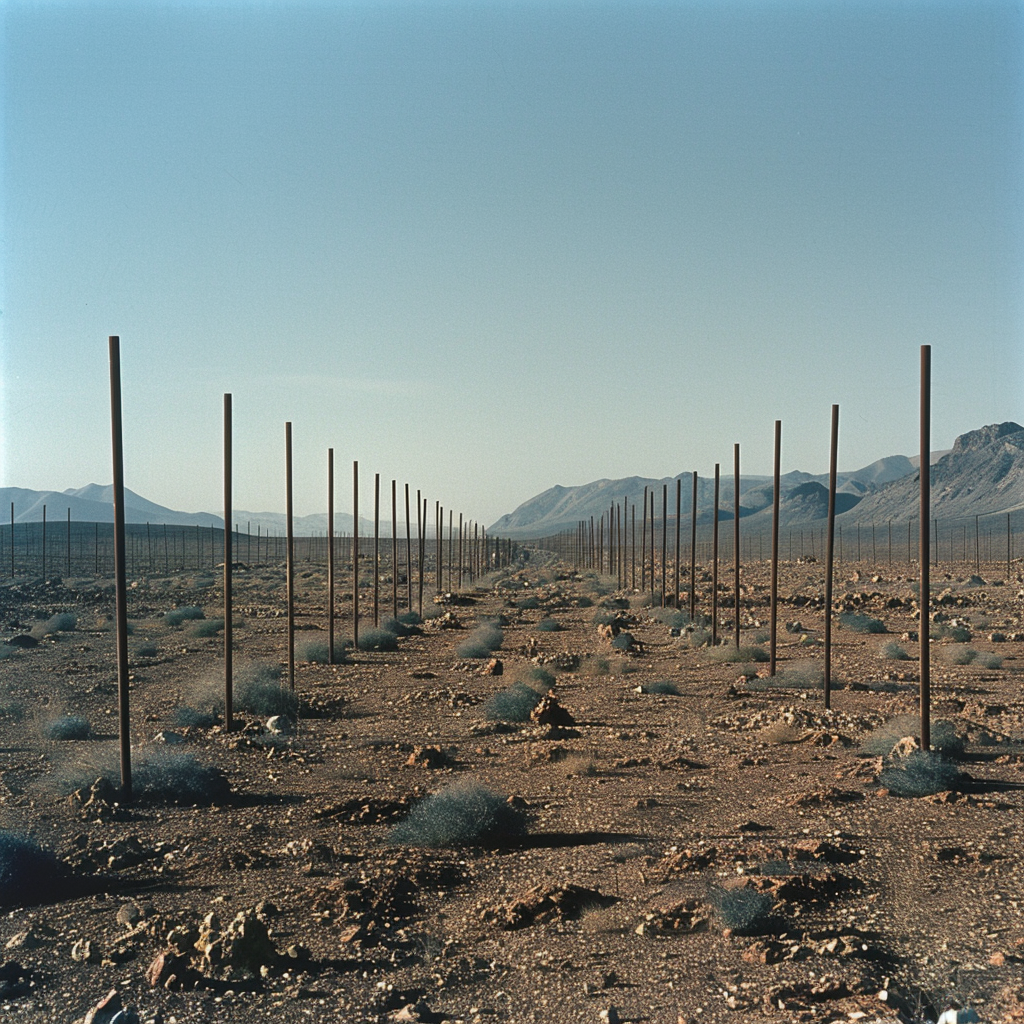
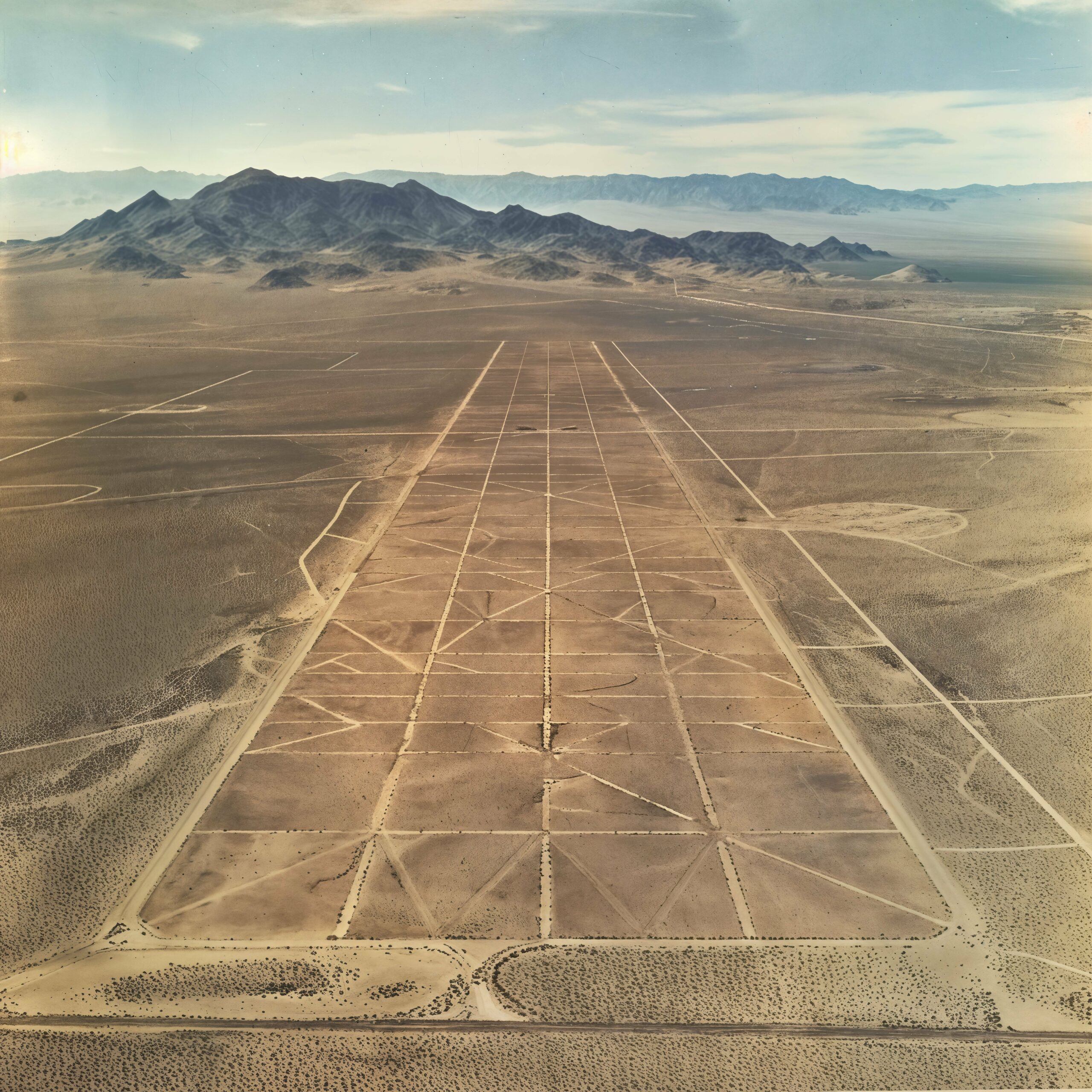
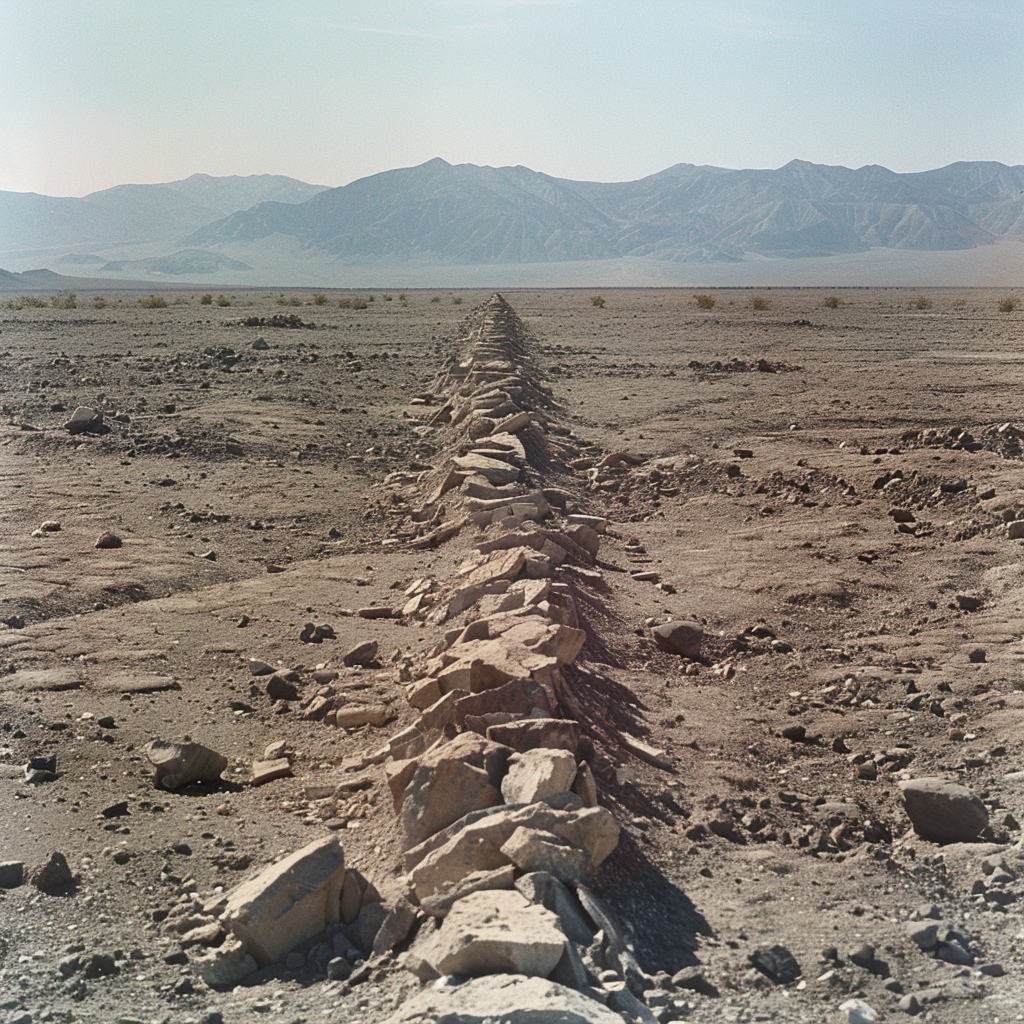
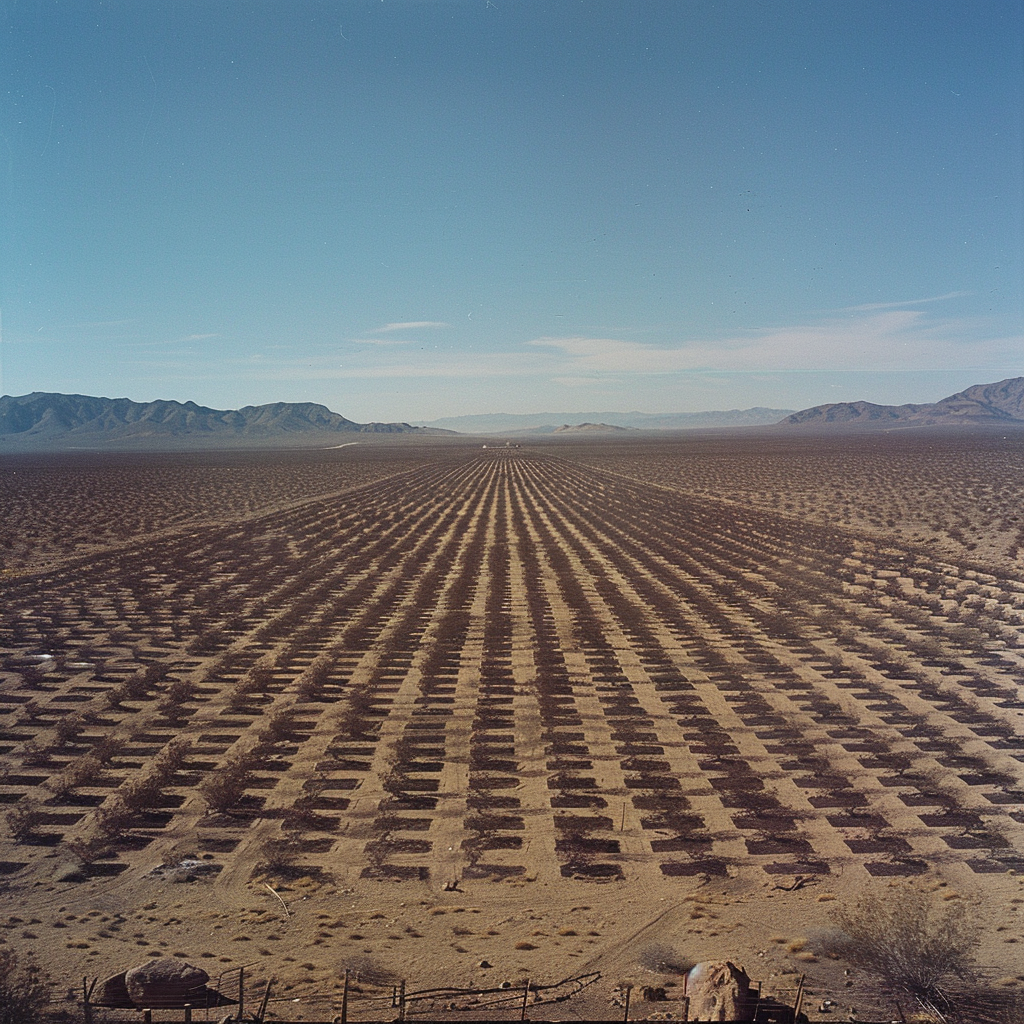
The other day, I posted some AI images of land art that doesn’t exist on Instagram. I didn’t have a plan for these, but I liked them and wanted to share them. In the comments, my friend the photographer Richard Barnes wrote, “This is our new world which for the moment is totally reliant on the old one.”

Richard is absolutely right and there is a lot to unpack in that sentence. To take one obvious reading, AI image generation is based on datasets of images on the Internet. You can read my extensive take on this in my last essay for this site, California Forever, Or the Aesthetics of AI Images, but today, I want to tackle the issue of AI imagery and originality.

My desire to make these images was backward-looking, or more properly, hauntological. Hauntology, a concept that emerged from the work of French philosopher Jacques Derrida, later popularized in cultural theory by Mark Fisher, suggests that the present is haunted by the unfulfilled potentialities of the past, creating a sense of nostalgia for lost futures that were never realized. Fisher writes: “What haunts the digital cul-de-sacs of the twenty-first century is not so much the past as all the lost futures that the twentieth century taught us to anticipate.” (Mark Fisher, “What is Hauntology?Film Quarterly, Vol. 66, No. 1 (Fall 2012), 16, article paywalled by JSTOR). For Fisher, much of recent culture is permeated by this hauntological quality, exploring historical references, styles, and ideas that never fully materialized in their own time.

If this concept is unfamiliar, then take the show Stranger Things. Set in the 1980s, not only does it explore the aesthetic and cultural motifs of that era, it revisits the past in ways that underscore the absence of the utopian visions once promised by that time. This is evident in the show’s theme song by Michael Stein and Kyle Dixon (a.k.a. S U R V I V E), informed by 1980s synthesizer music by musicians like Tangerine Dream, Giorgio Moroder, Jean-Michel Jarré, Vangelis, and John Carpenter and performed on modular synthesizers and vintage synthesizers from the 1970s. Through its retrofuturistic setting, supernatural elements, and cultural references, Stranger Things effectively embodies this hauntological sentiment, appealing to audiences by conjuring a collective memory of a past both familiar and lost, a space where the promise of progress and the fear of what lies in the unknown are in constant dialogue, thereby reflecting our contemporary longing for a future that seems increasingly out of reach in the face of technological stagnation and political paralysis. Throughout the series, an alternate dimension called “the Upside Down” functions allegorically as a manifestation of hauntology, representing the shadowy underside of progress and the hidden costs of failed utopias. This parallel dimension, while mirroring the physical world, is engulfed in darkness, decay, and danger, embodying the repressed anxieties not only of teenage sexuality—the familiar foundation of horror films—but also of the pursuit of advancement without ethical consideration. It can be interpreted as the tangible realization of the lost futures Fisher describes, a space where the dreams of the past are not just forgotten but actively twisted into nightmares. This allegorical realm underscores the series’ exploration of the impact of scientific hubris and the disintegration of the social fabric, issues that resonate with contemporary anxieties about technological overreach and the erosion of social bonds. Through the lens of the Upside Down, Stranger Things critiques the nostalgia for a past that never fully addressed these underlying tensions, suggesting that without confronting these spectral fears, they will continue to haunt us, impeding the realization of truly progressive futures.

Being born in 1967, I was in high school in 1983, the year in which the first season of Stranger Things is set, so I would have been older than the kids in Stranger Things, but the showrunners, Matt and Russ Duffer (the Duffer Brothers) were born in 1984. There is something about the era just before one is born and in the years before one forms lasting memories, that triggers the hauntological sense, particularly in regard to its relation to the Freudian uncanny (the unheimlich), which emerges not just as a theoretical concept but as a lived emotional reality, the encounter with something familiar yet estranged by time or context, generating an unsettling yet compelling attraction. The era immediately before one’s birth is fertile ground for the uncanny because it is inherently connected to one’s existence, yet it remains elusive and out of reach, shrouded in the fog of collective cultural memory rather than personal experience.

This is where my interest in Land Art, which thrived in the late 1960s and early 1980s comes from. It’s a mythic and heroic past, right outside the scope of my lived awareness. Land Art, moveover, is at a particular inflection in the Greenbergian history of modern art and one that brings us closer to our topic at hand. Art critic Clement Greenberg famously sought to distill the essence and trajectory of art through the modernist progression of self-criticism towards purity and autonomy, particularly in painting. Greenberg posited that art should focus on the specificity of the medium, leading to an emphasis on formal qualities over content or context. Specifically, Greenberg argued that modernist painters should embrace and explore the flatness of the canvas rather than attempt to deny it through illusionistic techniques that create a sense of three-dimensional space on the two-dimensional surface. He saw abstract expressionism and color field painting as driven by the gradual shedding of extraneous elements (like figurative representation, narrative, and illusionistic depth) that were not essential to painting as a medium. This process of reduction aimed at focusing on what was uniquely intrinsic to painting—its flat surface and the potential for pure color and form. This approach is distinctly indebted to Hegelian aesthetics, in which art is seen as a vehicle for the spirit (Geist) to realize itself, moving towards a form of absolute knowing or self-consciousness. The late 1960s projects of Minimal Art, Land Art, and Conceptual Art can all be seen as elaborations of Greenbergian modernism. Minimal Art, with its emphasis on the physical object and the space it occupies, pushes Greenberg’s interest in medium specificity to its logical extreme by reducing art to its most fundamental geometric forms and materials, thereby focusing on the “objecthood” of the artwork itself. Land Art extends this exploration to the medium of the earth itself, engaging directly with the landscape to highlight the intrinsic qualities of the environment and the artwork’s integration with its site-specific context, thus reflecting Greenberg’s emphasis on the inherent characteristics of the artistic medium. Conceptual Art, although seemingly divergent in its prioritization of idea over form, aligns with Greenbergian modernism by stripping art down to its conceptual essence, thereby challenging the traditional boundaries of the art object and emphasizing the primacy of the idea, akin to Greenberg’s focus on the essential qualities of painting and bringing art back to relevance as a philosophical discourse. Together, these movements expand upon Greenberg’s foundational principles by exploring the boundaries of what art can be, each pushing the dialogue about medium specificity and the pursuit of purity in art further.

Coming out of architecture and history, I find art without rigor frustrating and boring, so the art of the late 1960s and early 1970s is my north star and I am indeed something of a neo-Greenbergian (more on that here). But during the 1970s, the Greenbergian trajectory encountered significant challenges, marking a pivot away from these ideals towards a more fragmented, pluralistic understanding of art. Rosalind Krauss’s 1979 essay “Sculpture in the Expanded Field” serves as a critical juncture in this shift. Krauss dismantles the Greenbergian barrier between sculpture and not-sculpture by introducing a set of oppositions that allowed for a broader, more inclusive understanding of sculpture. This “expanded field” theory challenged the purity of medium specificity by embracing a wider range of practices and materials, effectively undermining the modernist notion of progressive refinement and autonomy of the arts. Krauss:

From the structure laid out above, it is obvious that the logic of the space of postmodernist practice is no longer organized around the definition of a given medium on the grounds of material, or, for that matter, the perception of material. It is organized instead through the universe of terms that are felt to be in opposition within a cultural situation.

Krauss’s essay, well-intentioned though it was, did not offer a positive direction for research in art, encouraging the sort of lazy pluralism and market-oriented art that has defined far too much art production in the years since.

The one exception to all this, however, is photography. If, in my essay on the aesthetics of AI images, I lamented the obsession with technical proficiency at the cost of taste in amateur HDR photography, in the hands of the best photographers —from the New Topographics movement in the 1970s to the work of great living photographers today, like Hiroshi Sugimoto, Guy Dickinson, David Maisel and Richard Barnes—the technical nature of photography is used to explore the photograph as a medium. And photography, by its very nature as an index of reality, its inexorable relationship between the subject and its representation—aligns with the Greenbergian ideal of art that is true to its medium more effectively than other media.

Rosalind Krauss, “Sculpture in the Expanded Field,” October, Vol. 8 (Spring 1979), 43.

Few artists have interrogated the roles of authorship, originality, and representation as effectively as the Pictures Generation, a loosely affiliated group of artists—mainly photographers—named after Pictures, a 1977 exhibition at New York’s Artists Space curated by Douglas Crimp. These artists embraced appropriation, montage, and the recontextualization of pre-existing images, deliberately blurring the boundaries between high art and popular culture and questioning the notion of an artwork’s purity and originality. Not all of this work still speaks to us today. John Baldessari’s art has aged poorly and many artists, such as Richard Prince, have long ago stopped doing interesting work. But at the time Prince, Cindy Sherman, Robert Longo (who admittedly also worked in paintings and charcoal, but in ways akin to the other four in this group), and Sherrie Levine produced compelling and rigorous work during this period. Crimp, on the name “pictures”:

To an ever greater extent our experience is governed by pictures, pictures in newspapers and magazines, on television and in the cinema. Next to these pictures firsthand experience begins to retreat, to seem more and more trivial. While it once seemed that pictures had the function of interpreting reality,it now seems that they have usurped it. It therefore becomes imperative to understand the picture itself, not in order to uncover a lost reality, but to determine how a picture becomes a signifying structure of its own accord. But pictures are characterized by something which, though often remarked, is insufficiently understood: that they are extremely difficult to distinguish at the level of their content, that they are to an extraordinary degree opaque to meaning. The actual event and the fictional event, the benign and the horrific, the mundane and the exotic, the possible and the fantastic: all are fused into the all-embracing similitude of the picture.

Douglas Crimp, Pictures (New York: Artists Space, 1977), 3.

For these artists then, the question of representation itself was fundamental, indeed the proper object for art. Crimp elaborated on this in a thorough revision to this essay, published two years later. This time, Crimp introduces the notion that these works demonstrate a postmodernist break with the modernist tradition:

But if postmodernism is to have theoretical value, it cannot be used merely as another chronological term; rather it must disclose the particular nature of a breach with modernism. It is in this sense that the radically new approach to mediums is important. If it had been characteristic of the formal descriptions of modernist art that they were topographical, that they mapped the surfaces of artworks in order to determine their structures, then it has now become necessary to think of description as a stratigraphic activity. Those processes of quotation, excerptation, framing, and staging that constitute the strategies of the work I have been discussing necessitate uncovering strata of representation.

Douglas Crimp, “Pictures,” October, Vol. 8 (Spring 1979), 87.

The astute reader might note that this is in the very same issue as the Krauss essay above. The issue, however, does not lead with either essay, but by a piece titled “Lecture in Inauguration of the Chair of Literary Semiology, Collège de France, January 7, 1977.” The author is, of course, the semiotician Roland Barthes and he is the crux to the argument of this essay. Barthes’s inaugural lecture at the Collège de France marks the acceptance of semiotics, the study of signs, in the university and sets out an agenda in which the field would not only attempt to analyze linguistic and literary matters but also provide a framework for decoding culture at large. Barthes is especially important to us in terms of his 1967 essay “The Death of the Author,” which was published in a widely read 1977 English collection of his works titled Image-Music-Text. In this essay, Barthes challenges traditional notions of authorial sovereignty by arguing that the meaning of a text is not anchored in the author’s original intent but is instead constructed by the reader’s engagement with the text. This radical shift foregrounds the role of the audience in creating meaning, suggesting that a work of art is a collaborative space where interpretations multiply beyond the author’s control. Intertwined with this concept is the idea of intertextuality, which posits that every text (or artwork) is not an isolated entity but a mosaic of references, influences, and echoes from other texts. Intertextuality underscores the interconnectedness of cultural production, indicating that the understanding of any work is contingent upon its relation to the broader network of cultural artifacts. Together, these concepts dismantle the traditional hierarchy between creator and receiver, emphasizing the active role of the reader or viewer in making meaning and highlighting the complex web of relationships that define the production and reception of art.

This perspective was crucial for the Pictures artists who frequently employed appropriation as a strategy, taking pre-existing images from various media and recontextualizing them in their art. This method directly engaged with Barthes’s idea by challenging the original context and intended meaning of these images, thus questioning the notions of originality and authorship. In doing so, they highlighted the idea that the creator’s authority over an artwork’s meaning is not absolute but rather shared with viewers, who bring their own interpretations and experiences to bear on the work.

Moreover, these artists applied Barthes’s concept to emphasize the fluidity and contingency of meaning. Their work often invites viewers to interpret images through their own cultural references and personal experiences, suggesting that meaning is not a fixed entity but a dynamic interaction. In critically engaging with the proliferation of images in contemporary society, the Pictures Generation explored how photographic and cinematic imagery shapes perceptions of identity and reality. This critical stance aligns with Barthes’s view of the text (or image) as a fabric of quotations and influences, further diminishing the role of the author in favor of a more collaborative and interpretive approach to meaning-making.

Crucially, this shift also led to a reevaluation of the artist’s identity. Rather than being seen as the singular source of meaning, artists of the Pictures Generation positioned themselves more as curators or commentators, utilizing the visual languages of their time to critique cultural norms and values. This reflects a move away from the modernist emphasis on the artist’s unique vision toward a recognition of the complex, contextual nature of art-making and interpretation.

Barthes’s idea—that the author’s intent and biography recede in importance compared to the reader’s role in creating meaning—parallels a shift towards viewing the artwork itself, and its reception, as central to its interpretation. This shift can be seen as aligning with Greenberg’s emphasis on the medium’s physical and visual properties as the locus of artistic significance, and Hegel’s idea of art revealing universal truths, though through a more contemporary lens focused on the viewer’s engagement.

But practices such as appropriation, pastiche, and intertextuality can also be framed as a mannerist lament, a response to a widely perceived exhaustion of possibilities within modernism. Compounding this, with the postwar rise of commercial art and Pop art, capital was thoroughly permeated by the strategies of the avant-garde and vice versa. Even shock, the classic technique of the avantgarde had been turned into a marketing tool, signaling the thorough co-option of avant-garde tactics by the very systems it sought to critique. The avant-garde‘s political validity was now deeply in question, something elaborated in the 1984 translation Peter Bürger’s Theory of the Avant-Garde. In this complex landscape, the Pictures Generation’s engagement with the visual language of mass media becomes a double-edged sword: a critique of—and a capitulation to—the pervasive influence of commercial imagery, reflecting a nuanced understanding of the impossibility of purity in an age dominated by reproduction and simulation.

If the Pictures Generation’s engagement already sounds like what Richard Barnes suggested in his comment, “This is our new world which for the moment is totally reliant on the old one” then perhaps this suggests a profitable route to investigate. Hal Foster, Rosalind Krauss’s student and Douglas Crimp’s contemporary (as well as my teacher at Cornell for a brilliant year) was a key critic for the Pictures Generation and his 1996 book, The Return of the Real, remains one of the deepest theoretical engagements with art from the late 1960s to the mid-1980s. There, Foster introduces the concept of “Nachträglichkeit,” a term borrowed from Freudian psychoanalysis, often translated into English as “deferred action.”

Nachträglichkeit refers to the way in which events or experiences are reinterpreted and given new meaning in retrospect, influenced by later events or understandings. It suggests that the significance of an artwork or movement is not fixed at the moment of its creation but can be reshaped by subsequent developments in the cultural and theoretical landscape. This recontextualization allows for a continuous reworking of the meaning and relevance of art, as past works are seen through the lens of present concerns and knowledge.

Foster applies this concept to the realm of art history and criticism to argue that the avant-garde movements of the early 20th century, for example, can be re-understood and gain new significance in light of later artistic practices and theoretical frameworks:

In Freud an event is registered as traumatic only through a later event that recodes it retroactively, in deferred action. Here I propose that the significance of avant-garde events is produced in an analogous way, through a complex relay of anticipation and reconstruction. Taken together, then, the notions of parallax and deferred action refashion the cliche not only of the neo-avant-garde as merely redundant of the historical avant-garde, but also of the postmodern as only belated in relation to the modern. In so doing I hope that they nuance our accounts of aesthetic shifts and historical breaks as well. Finally, if this model of retroaction can contribute any symbolic resistance to the work of retroversion so pervasive in culture and politics today—that is, the reactionary undoing of the progressive transformations of the century—so much the better.

Hal Foster, The Return of the Real (Cambridge: The MIT Press, 1996), xii-xiii.

This perspective challenges linear narratives of art history that portray artistic development as a straightforward progression from one style or movement to the next. Instead, Foster emphasizes the recursive nature of artistic innovation, where contemporary artists engage with, reinterpret, and transform the meanings and methodologies of their predecessors. This is where a critical approach to AI imagery that explores the intertextual basis of all art might return to our narrative. In this light, Pictures anticipates a world in which imagery can be freely recombined, in which the role of the author is thoroughly questioned, and the status of the original is thrown into question.
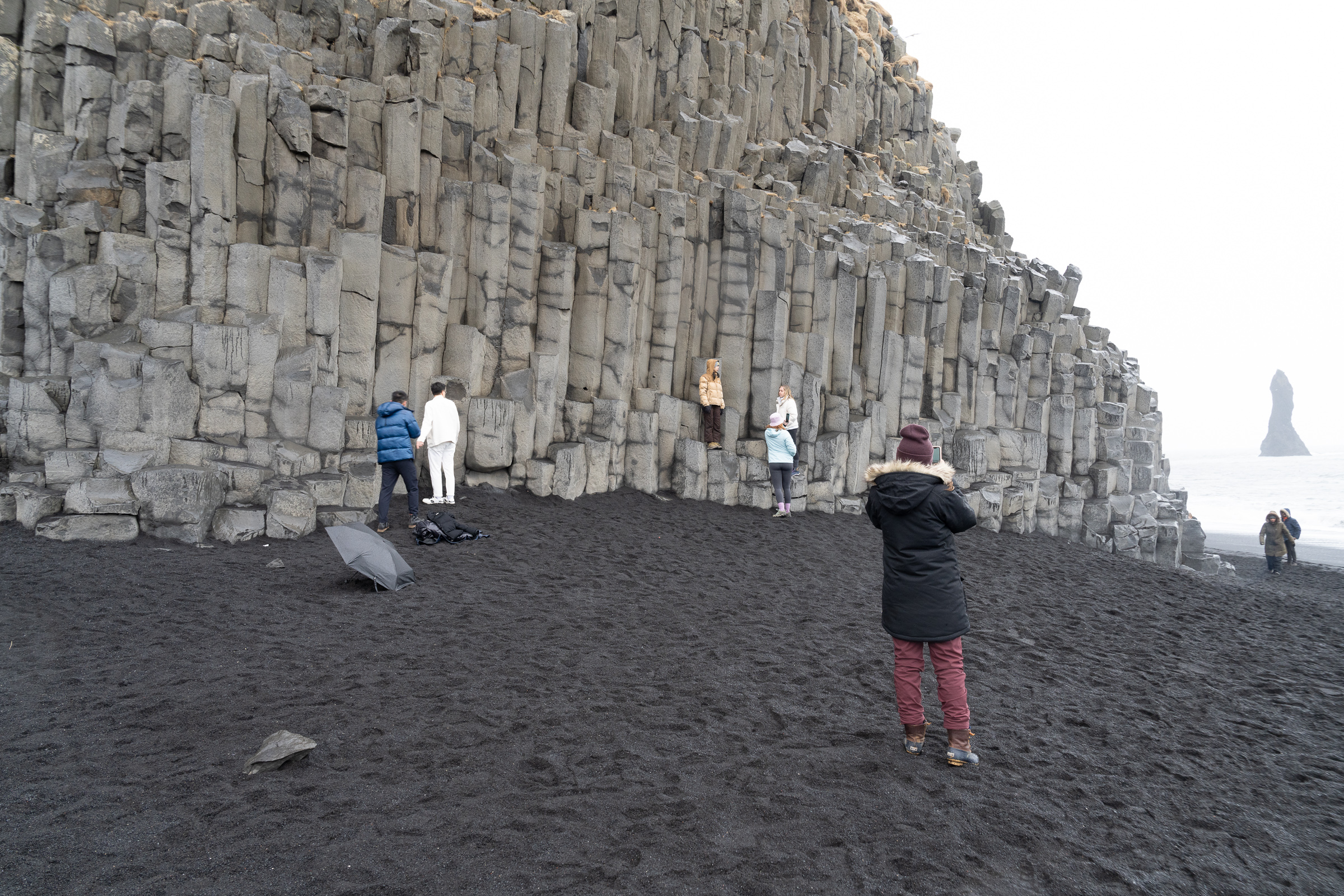
Oversaturation. Reynisfjara, Iceland, 2023.

But more than that. Back to Instagram for a moment. Another phenomenon that we have to deal with—that the Pictures Generation did not—is the massive oversaturation of the landscape by user-generated content. This deluge of imagery created by the public—particularly while travelling—has transformed the visual ecosystem, challenging artists to find new methods of engagement and critique. The sheer volume of content complicates efforts to distinguish between the meaningful and the mundane, pushing contemporary artists to navigate and respond to a world where the boundaries between creator and consumer are increasingly blurred. This oversaturation demands a different reevaluation of originality, authenticity, and the role of art in reflecting and shaping societal narratives in the digital age. The are some 35 billion images posted on Instagram every year. These are not just private images, but images that are published in a way previously unimaginable—available to an audience of over a billion users. What does it mean to take a photograph today when the world is already oversaturated? What sense is there of taking a photo of a landscape or a street scene when the same image has been uploaded a thousand times? And what does it mean that serious artists and curators share—by choice or by necessity—work in that same milieu?

Most of the images on Instagram are already AI images. The reason an iPhone or a Pixel can take such an attractive photograph is that they possess highly sophisticated algorithms that create images that appeal to viewers. The iPhone, for instance, utilizes AI-driven features like Smart HDR and Deep Fusion. Smart HDR optimizes the lighting, color, and detail of each subject in a photo, while Deep Fusion merges the best parts of multiple exposures to produce images with superior texture, detail, and reduced noise in low-light conditions​​​​. The iPhone’s Neural Engine, part of its Bionic Chip, executes these complex processes, handling up to 600 billion operations per second, to deliver photographs that were unimaginable with traditional digital imaging techniques​​. Given the insane number of photographs taken at “Instagrammable” sites, and the ecological and social damage that such travel produces, one wonders if something like Bjoern Karmann’s Paragraphica camera might not be a better solution. Using various data points like address, weather, time of day, and nearby places, the Paragraphica then creates a photographic representation using a text-to-image AI generator. This isn’t to say that photography as art is extinct, but it is in peril thanks to oversaturation, which itself is so prolific it has become meaningless.

Another option might be to think of how Critical AI Art, distinguishing itself from the oversaturation of prevalent AI imagery might reflect on the profound shift in art’s interaction with technology and culture, revisiting themes central to the Pictures Generation—such as media influence and appropriation—through the lens of contemporary digital practices. By employing generative algorithms, this approach not only generates new visual forms but also engages critically with the saturation of images, probing the essence of authenticity, originality, and the evolving role of both artists and non-artists. This dynamic interaction underscores a broader, ongoing dialogue with the history of art revealing how artistic methodologies are shaped by the recursive nature of cultural and technological advancements. Here, a hauntological approach to AI Art be productive, such as the theory-fiction project I did last year, On an Art Experiment in Soviet Lithuania which reflects on the refusal of the avant-garde by the Soviet Union, the loss of Lithuania’s freedom to Soviet-Russian rule between 1945 and 1991, and art in the 1970s.

But there are other possibilities for using AI to make art. I’d like to conclude by citing one key artist from the Pictures Generation who I haven’t mentioned: David Salle. Curiously Salle is one of the only serious artists without a technology background to be publicly experimenting with AIs. Salle’s process has always been characterized by an innovative use of imagery and a negotiation back and forth between media, often starting with photographs he takes, which serve as the basis for his layered and complex paintings. Described in a lengthy New York Times article entitled “Is This Good Enough to Fool my Gallerist?” Salle’s method reflects a blend of the real and the conceptual, pushing the boundaries of narrative and abstraction in his work​​. Starting in 2023, Salle and a team of computer scientists worked on an iPad-based program trained on a dataset of his paintings and refined based on his input, showcasing an example of how AI can be employed to conceptualize variations of artwork, aiding in the brainstorming process for new paintings​​. Salle’s foray into AI art can be seen as an example of critical AI art, where the use of technology is not merely for the creation of art but serves as a commentary on the process of art-making itself. By integrating AI into his practice, Salle engages in a dialogue with the contemporary art world about originality, creativity, and the role of the artist in the digital age. Concluding the article, journalist Zachary Small lets Salle have the last word.

What will become of his own identity, as the algorithm continues to produce more Salle paintings than he could ever imagine? Some days, it seems like the algorithm is an assistant. Other days, it’s like a child.

When asked if the A.I. would replace him entirely one day, the artist shrugged.

“Well,” he said, “that’s the future.”

Can David Salle Teach A.I. How to Create Good Art? – The New York Times (nytimes.com)

A future, which is still totally reliant on the past.

One last point. As is my wont, in this essay I have focused on art from the 1960s onwards, but there are other models that might come to the fore again in this era. In particular, the Renaissance model of inspiration is an interesting one to reflect upon. Renaissance art theory was underpinned by the concept of imitatio (imitation), which was considered a noble pursuit. Imitation in the Renaissance sense involved studying and emulating the excellence of ancient art to grasp its underlying principles of beauty, proportion, and harmony. However, this process was not about mere copying; it was about surpassing the models from the past, a concept known as aemulatio. And that, very well, may be the future (of the past) in our art.

A Chapter on Atemporality

I’ve put a revised version of the introduction to my book on network culture together with the first chapter—on atemporality—on my site. I hope you’ll be as excited to read this material as I am to post it.

I know that I owe my most readers a few words of explanation about why it took over a year to post a chapter that I had initially thought I’d have up within a couple of months.

First, I had the honor of writing a chapter in Networked: A (Networked) Book on (Networked) Art. As part of this project, I agreed that I wouldn’t take the material for the chapter and immediately publish it on my own site. That material, like a lot of the research I  did last year requires substantial reworking to fit the book (little of it is in the first chapter…you’ll see it later, in the chapter on poetics).

Second, I’ve thoroughly rethought the book during the intervening year not once but repeatedly. This is hardly a crisis, but rather the way that I—and many historians—write. Revise again and again as you nibble at unformed parts until everything comes together.

Some of you have asked how the revision process works, so I’ve left the record on the site, just go to the revisions tab for any section and compare the current version with earlier ones. Of all the revisions, the most significant is a new model of historical succession that I find simply works for network culture. Whereas last year I had some uncertainty about just how this book would be a history, the first chapter—which of course is on history—now makes my strategy of relying on Michel Foucault and Jeffrey Nealon’s model of intensification emphatically clear.

Speaking of revisions, make no mistake, there are plenty of rough patches in these chapters. This is, after all, a draft. Don’t  read it if you want a finished product. But also don’t think you should hold back on your commentary. Whether at Networked or at the other ventures including this one, networked books have largely failed at generating comments. Don’t let that stop you. If you see a problem in the text call me out on it wherever you feel appropriate. The more that I can draw on the massive collective intelligence of my readership, the better this project wil be.   

While I’m on the topic of collective intelligence… This first chapter owes much to a dialogue that Bruce Sterling and I have maintained between our blogs (take, for example, Bruce’s discussion of atemporality in his keynote address at Transmediale this year) and on Twitter with many of you. All of the kind attention that this dialogue brought during the first few months of the year makes me think that my attempt to write a history of atemporality is both timely and untimely (in Nietzsche’s sense).

Finally, a word about the book title. It’s very much in flux now, but I’m thinking it might be "Life After Networks: A Critical History of Network Culture."