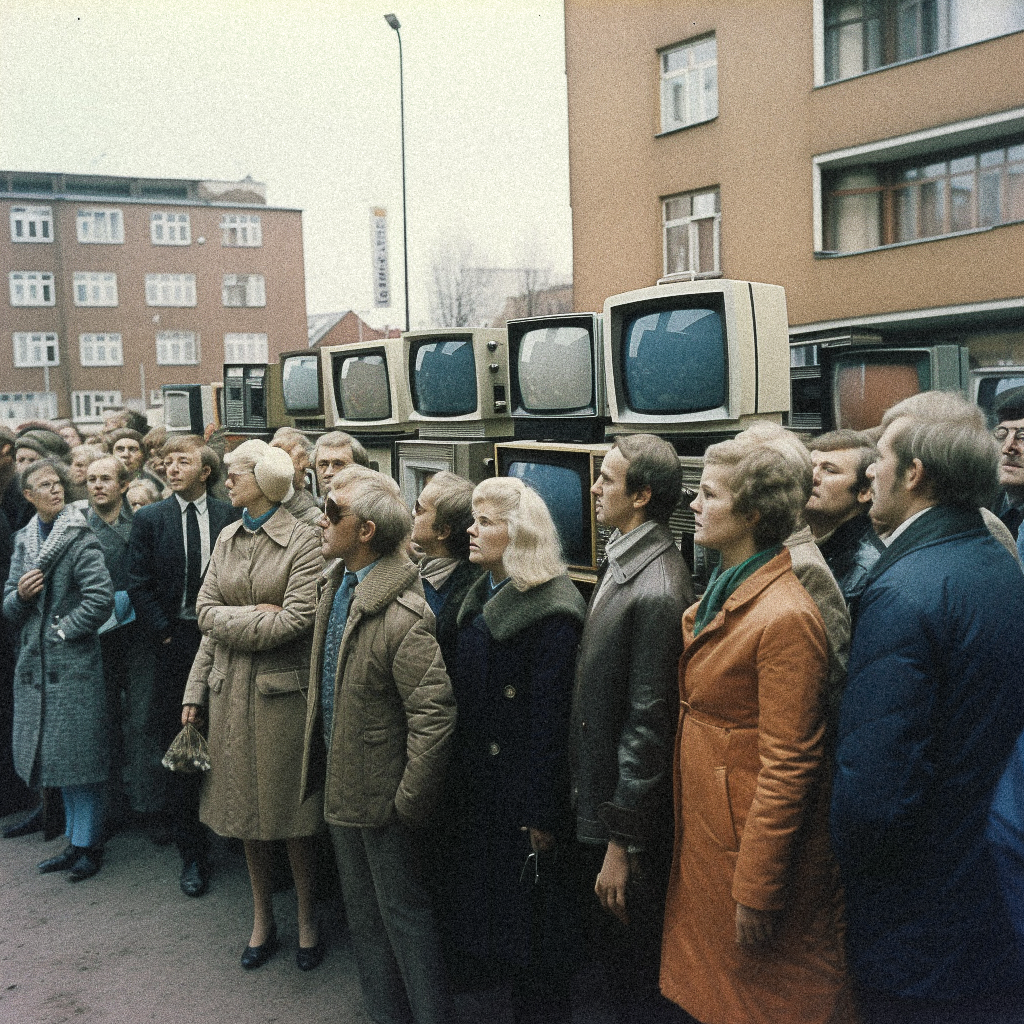
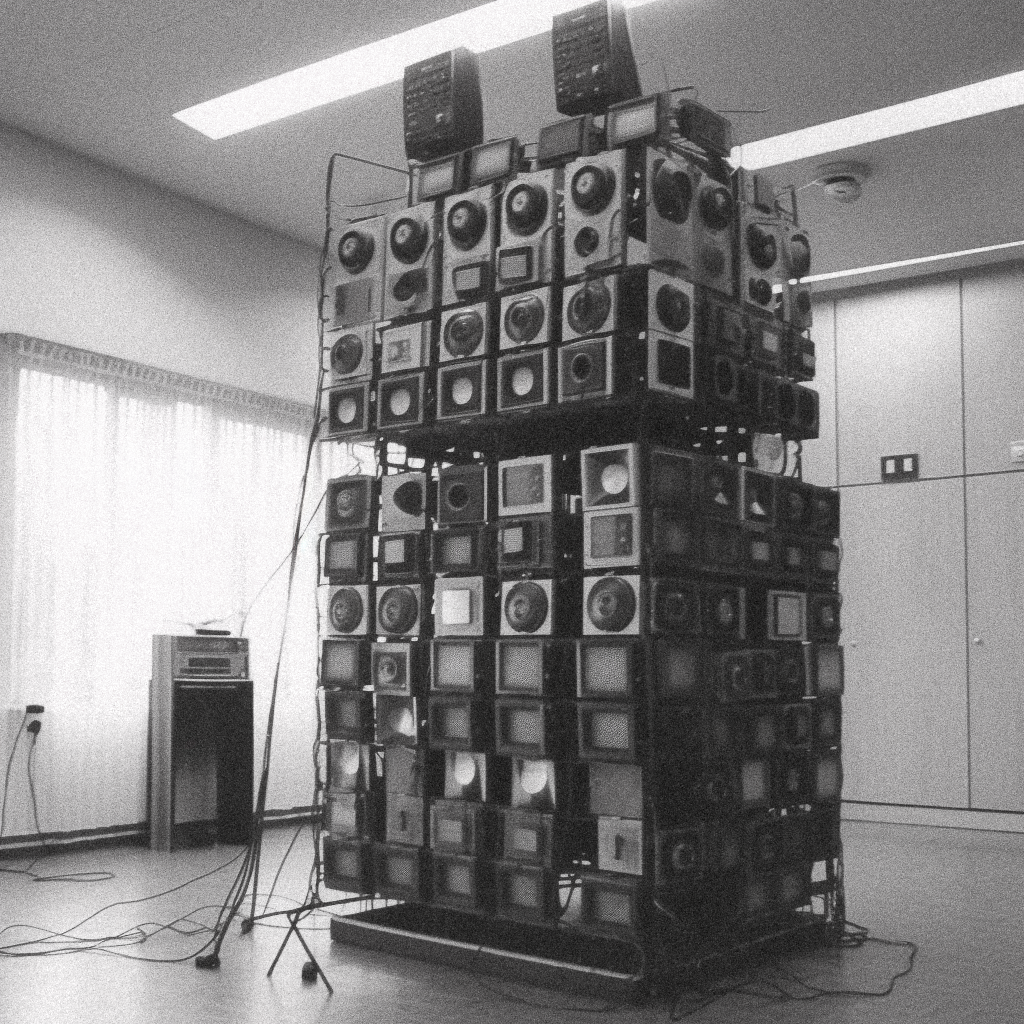
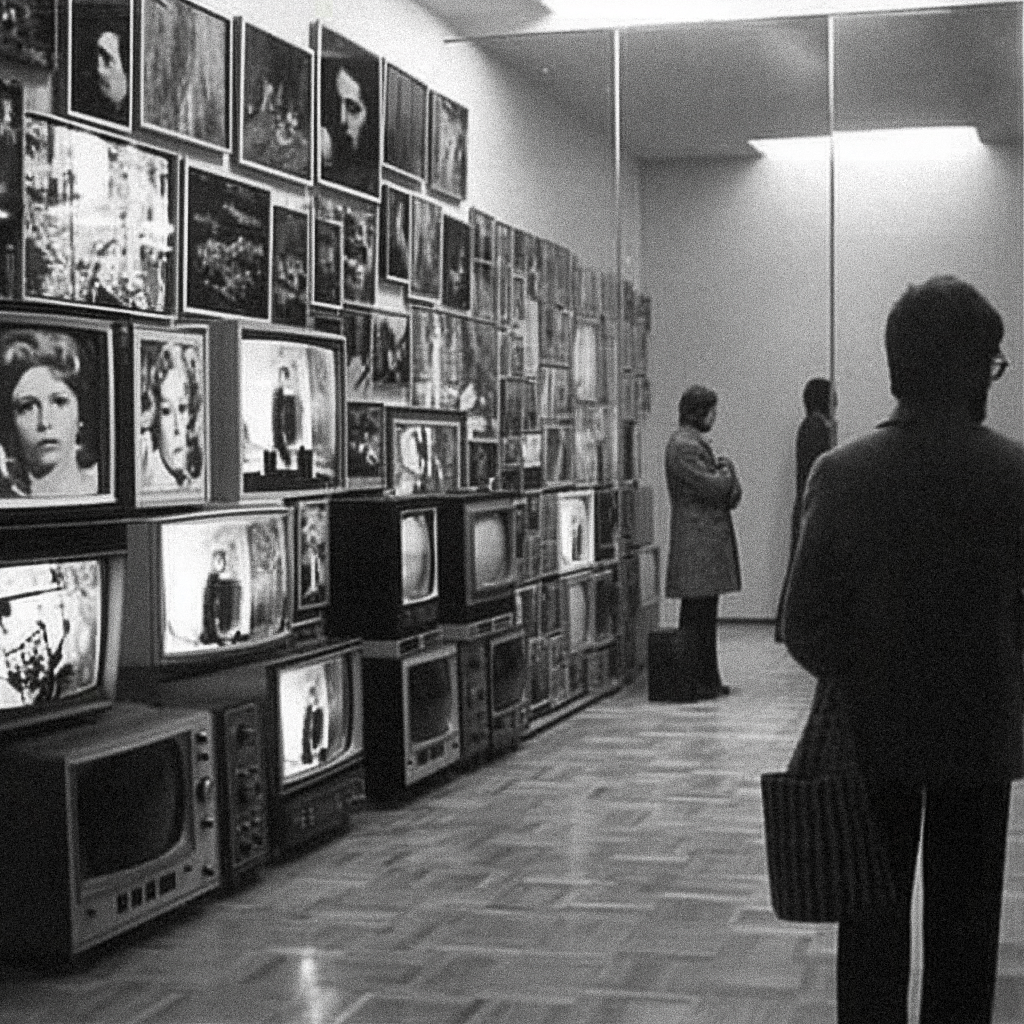
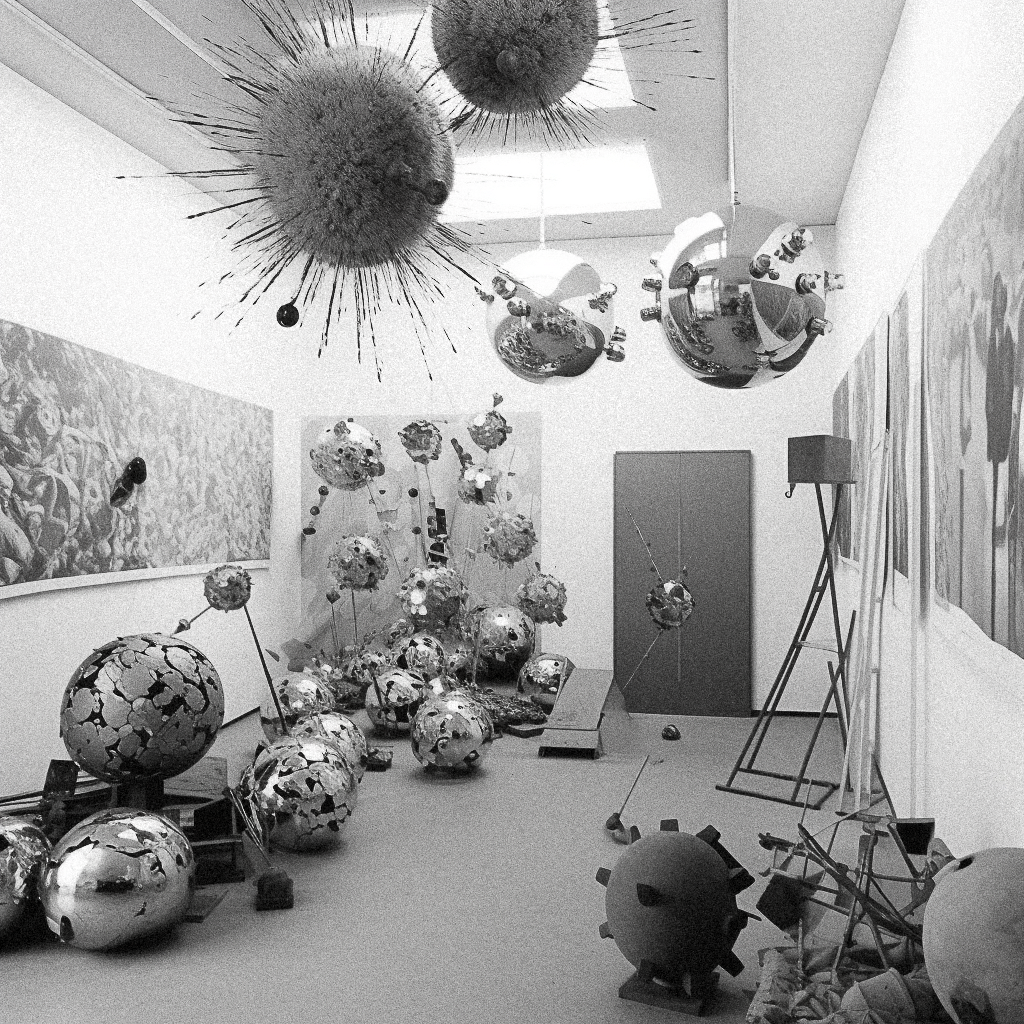
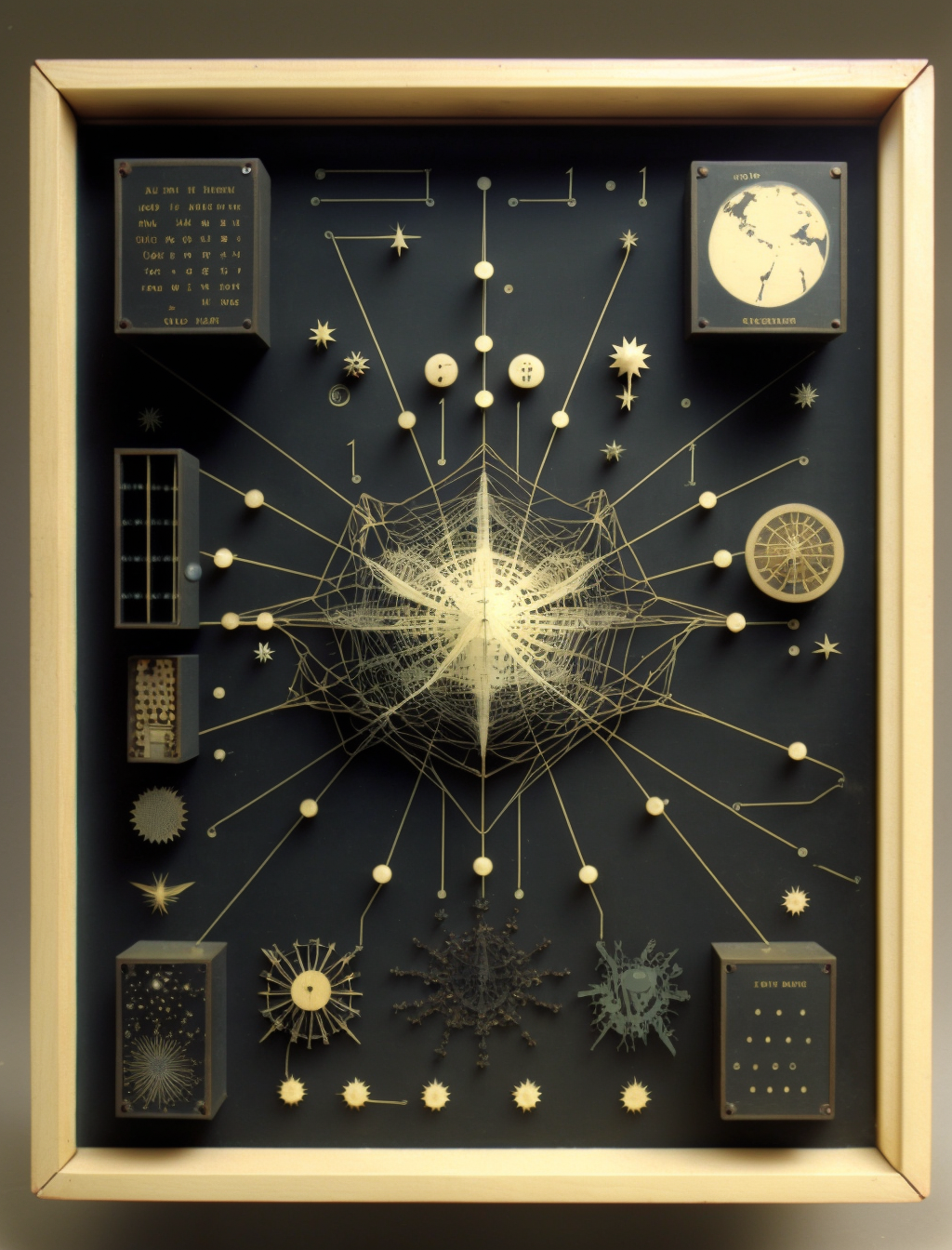
I have forty-four long-form posts since 2019 for your reading pleasure below, but perhaps you’d like to read a few words on how they came to be first?
I am happier writing for myself than I ever was writing for anyone else (although I will do that again, too, in case you have an interesting proposal). But even if I am thrilled with the WordPress layout I designed for varnelis.net, I realize that it isn’t ideal for reading a 6,000-word essay. But what website is? There is little question that PDFs are easier to read, whether on a tablet or in print. This, however, led me to a problem. Do I want to lay out every longer-form post since 2019 again? No.
There are, unfortunately, no PDF renderers for WordPress that satisfy me, and that makes sense. Exporting to a PDF is a complicated project, and when you are a modernist, your site has large graphics, and you write essays, not posts, you really need something custom, which, of course, was impossible until recently. But vibe coding has advanced significantly since I wrote about it in December’s “What Did Vibe Coding Just Do to the Commons?”
Some encounters put me in a foul mood yesterday morning, so as sometimes happens, I became extra productive and I set out to build a small piece of bespoke software for this site: a local Mac app that fetches my published WordPress posts, gathers the images and captions, lays everything out in a restrained publication format, and then lets me review the result before uploading it back to the site automatically. If you still, somehow, think that AI is not useful for anything, please check out the PDFs below and tell me how long it would have taken you to write a comparable application to translate them from HTML? Things have changed a great deal since 2023. I used ChatGPT’s Codex to write this code, and, unlike my experience in December, I was a distracted supervisor all day, cleaning up, working on the draft of the introduction to my next book, the Generative Unconscious (this will be the subject of an e-mail later this week, likely tomorrow). There was no endless babysitting; Codex just built the application, at one point going off to code for over 90 minutes.
There is something important here to me, which is the return of computing to something more personal, something I own because I made. I am not planning to distribute this, since it is too idiosyncratic a project; this is bespoke software, and, if the code was written by an AI, nobody else would have come up with the same result. It reminds me very much of the early days of personal computing, when users (like me) routinely wrote small programs for their own needs: a database for a player-piano sheet-music collection, an extension to BASIC to enable better graphics, a tool for managing all the shareware I had downloaded. Software often did not come in a shrink-wrapped package, obtained by online subscription, or downloaded from a carefully gated store. Software was closer to a workshop practice. You made tools when the available ones did not quite fit the work, or you remade them, often again and again.
My PDF renderer is in that spirit. It is software made for one site, one archive, one way of writing and publishing. That specificity is the point. As AI makes it possible to roll one’s own programs again, we will see more of this: not just apps built for markets, but tools built for particular lives, practices, archives, gardens, and bodies of work. Sometimes living in interesting times isn’t all bad.
Author’s note: This is a draft of an introduction to the Generative Unconscious. It will be improved for a time. The chapters linked at the end are all drafts as well, but you can get the gist of the book now. You can download a rough draft of the book generated by an automatic WordPress to PDF generator, here.
Few consumer technologies have provoked as much consternation as artificial intelligence, especially in the arts. Much of this anxiety is economic: commercial artists, in particular, fear the replication of their styles by hobbyists using generative tools. For them, the threat is acute because they already operate in a commodified space, producing repeatable stylistic signatures, conventions, and deliverables within established genres and franchises. This account is not wrong, but it is insufficient. The intensity of the reaction, especially among critics, suggests that something more than livelihood is at stake. In this book, I argue that the fear of AI is the fear of seeing the human in the nonhuman: the recognition that these systems externalize the very mechanisms of cultural production once attributed to intention, imagination, and inner life.
Culture is, fundamentally, a historical product, made up of patterns, inherited forms, and the accumulated debris of everything made before. In The Political Unconscious, Fredric Jameson argues that every cultural artifact is shaped by ideological and historical forces operating below the threshold of individual awareness: we never confront a text as a thing-in-itself, but rather we apprehend it through sedimented layers of previous interpretation, expectation, and inherited form.1 In Large Language Models (LLMs), this condition becomes literal. Every utterance is generated from the statistical weight of prior text. My concept of the generative unconscious extends Jameson’s insight into the domain of artificial intelligence: the ideological and historical forces that shaped cultural production below the threshold of awareness are now encoded as statistical distributions across billions of parameters.
But if my thesis in this book is that AI makes visible what was always operating in cultural production, then that visibility is historical, not merely sequential. I find a model for this in Hal Foster’s The Return of the Real (1996), in which he repurposes Freud’s psychoanalytic concept of nachträglichkeit—deferred action—as a historiographic structure, proposing that cultural moments relate to their predecessors through what he called “a complex relay of anticipated futures and reconstructed pasts.” The latter moment does not simply repeat the earlier one; it comprehends it for the first time. Foster’s central argument is that the neo-avant-garde did not cancel the historical avant-garde but rather revealed what its predecessor could not yet grasp about itself. Thus, Duchamp’s readymade became legible as institutional critique only through the Conceptualists’ later elaboration; Constructivism’s investigation of the object became legible as phenomenological inquiry only through Minimalism. Foster developed this model for art, but the same temporal structure operates in technology. In the Arcades Project, Benjamin read the iron-and-glass architecture of the nineteenth century as the dream-images of an epoch, legible as such only from the vantage of the twentieth century that they unconsciously anticipated. Each technological system gives its predecessors new meaning by revealing what had remained unnamed within them.2
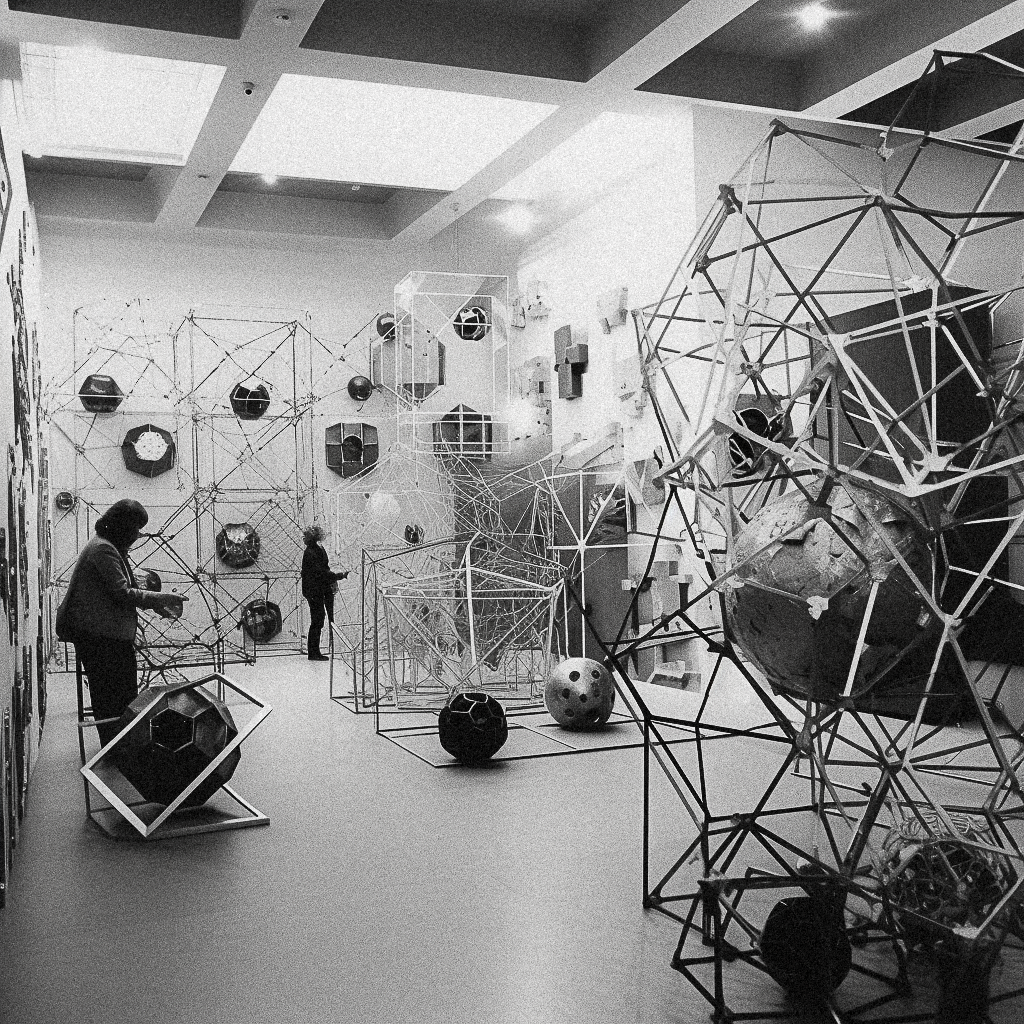
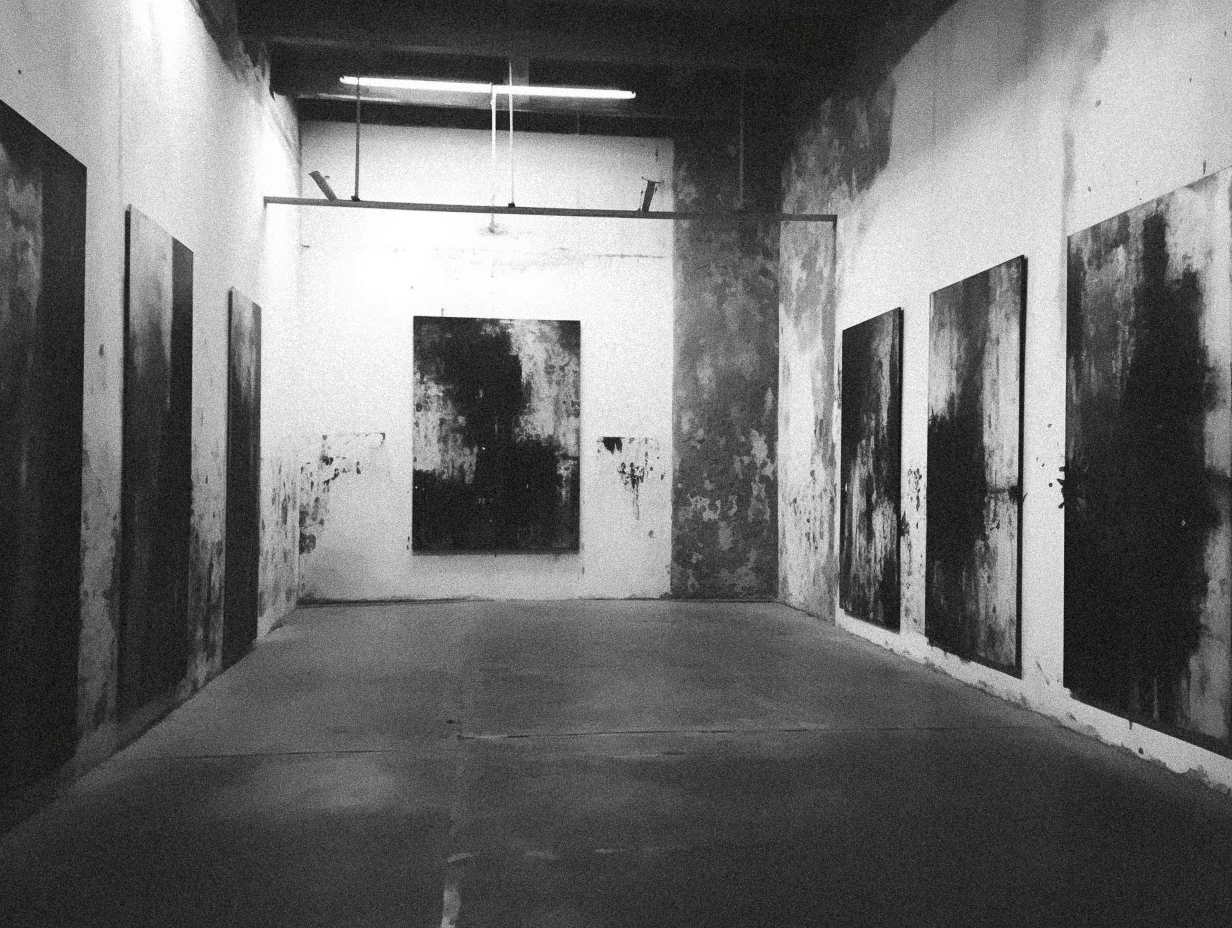
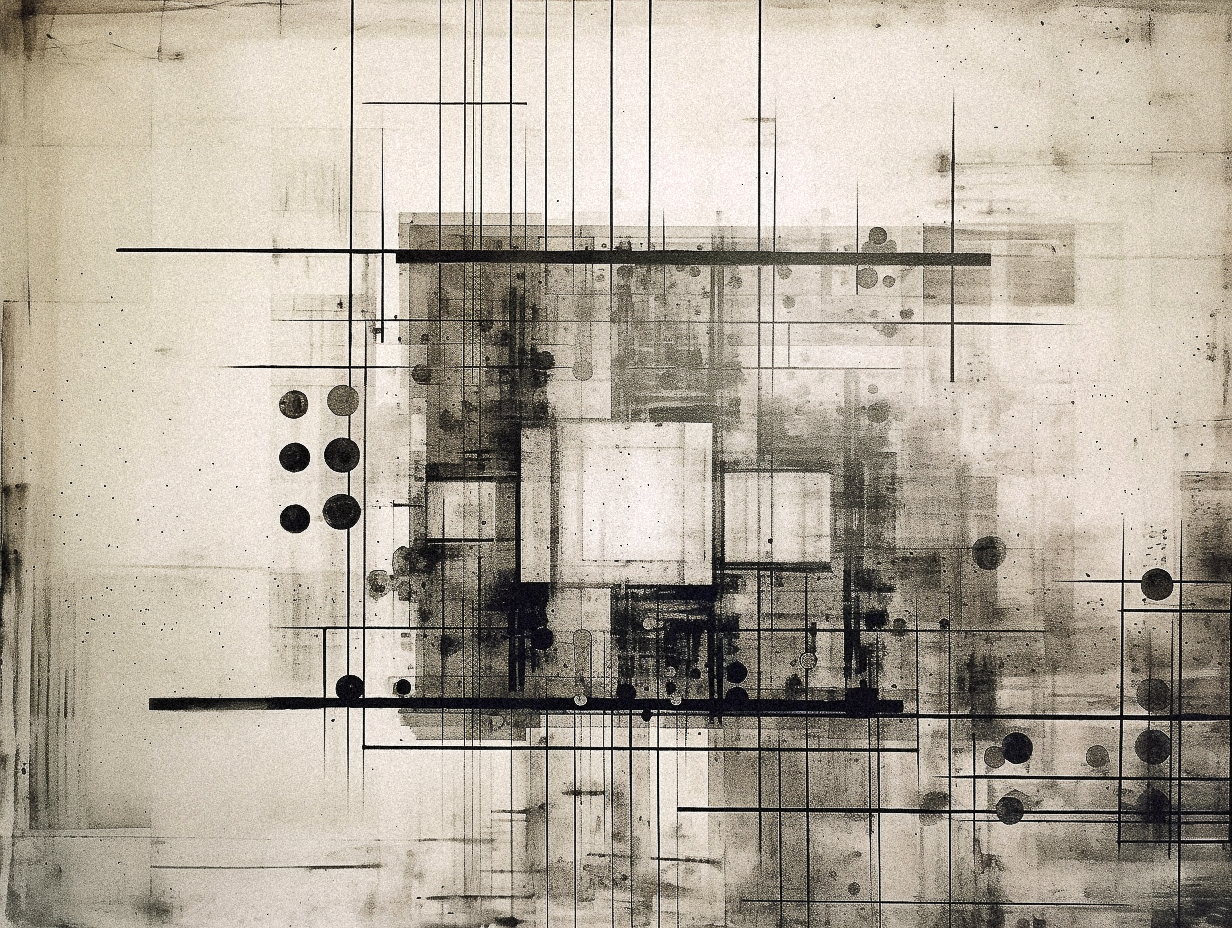
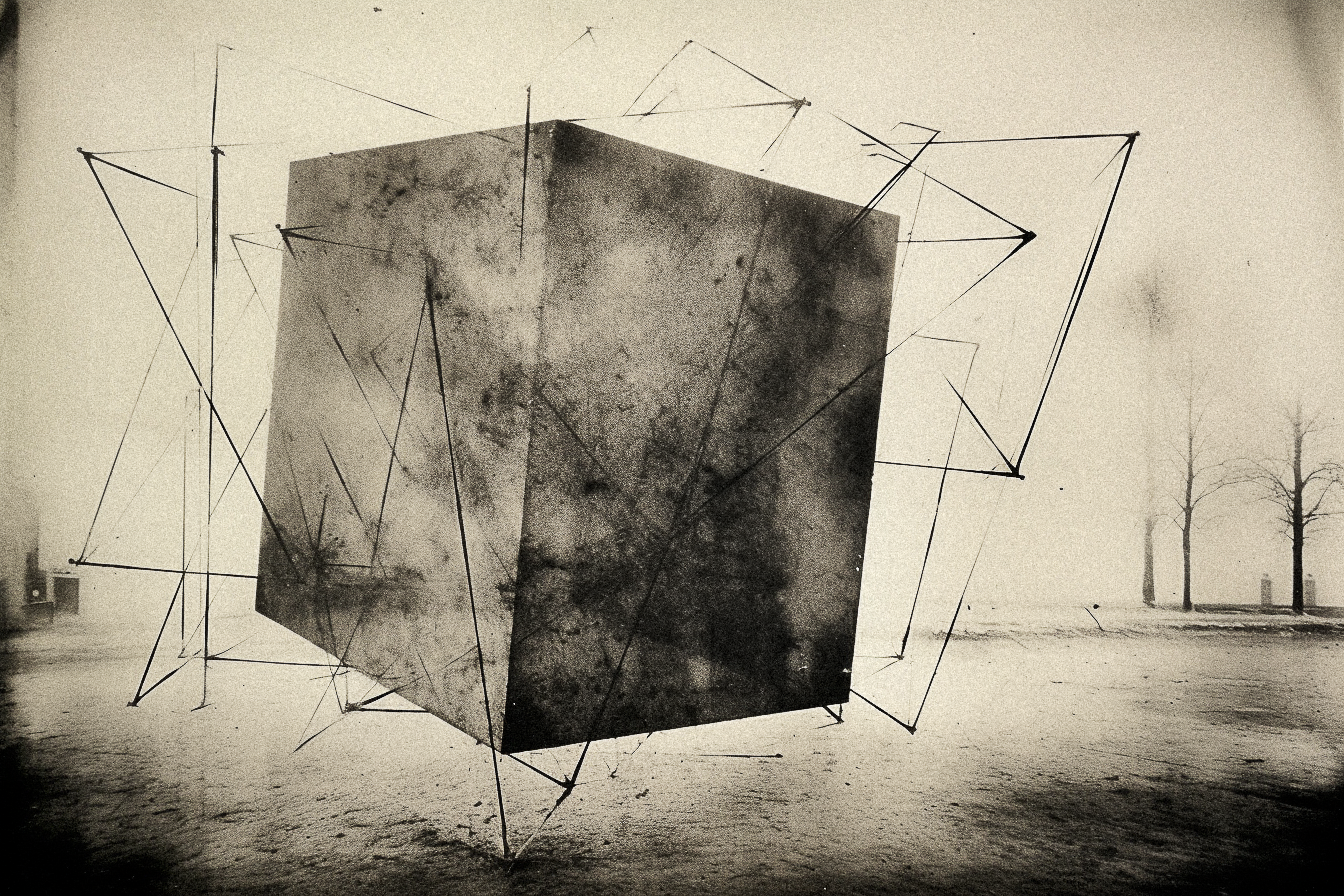
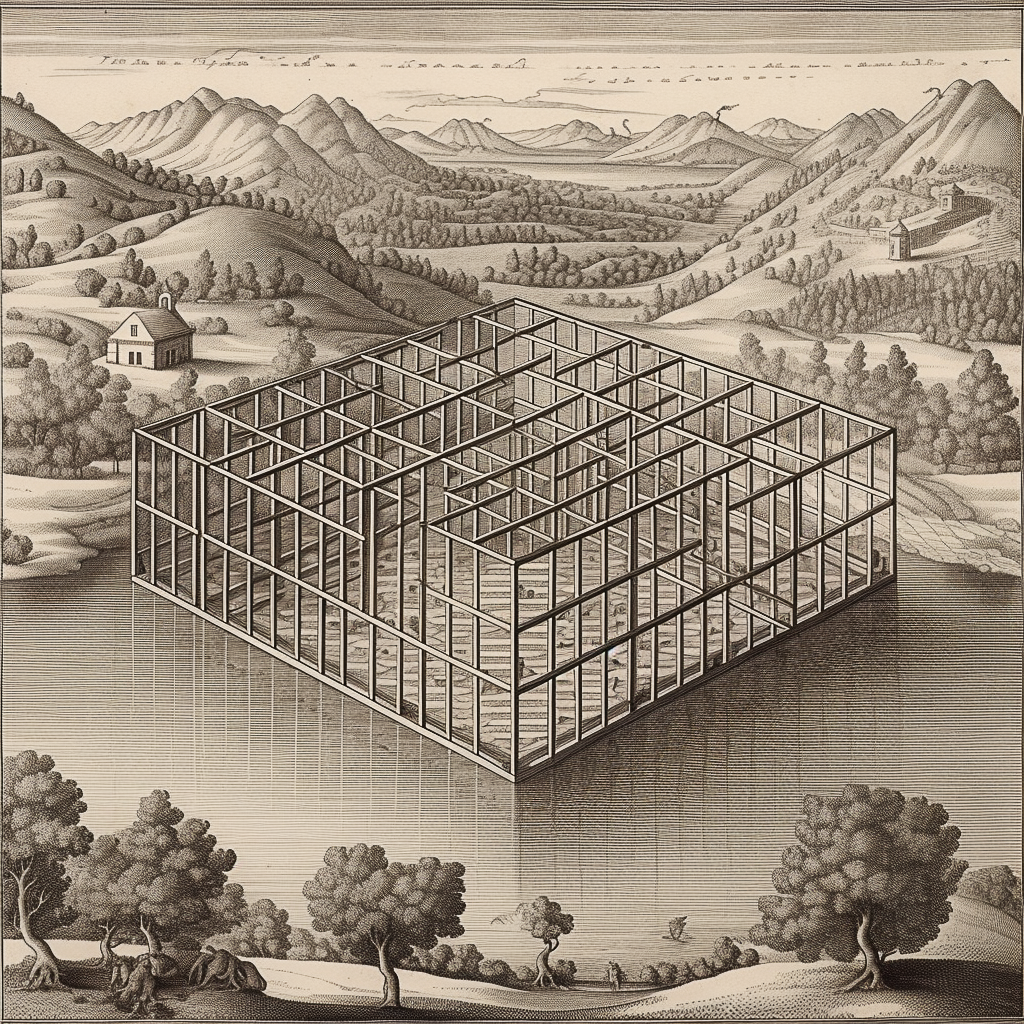
FLUX.1-dev (Black Forest Labs, 2024), 1024×1024 per cell, three seeds × five inference-step budgets. Prompt: “Lightning Field, four hundred polished stainless steel poles arranged in rectangular grid on a flat high-desert plain, raking golden sunset light catching the polished poles, distant mountain silhouettes on the horizon.”
To theorize AI, we may ourselves have to perform the operation that Foster attributes to the neo-avant-garde, so as to disconnect from a poorly theorized present by returning to the theory of an obsolete past. Perversely, that past is ossified postmodern theory itself. Postmodern and poststructuralist authority once seemed almost total. For three decades, Roland Barthes, Julia Kristeva, Michel Foucault, Jacques Derrida, Jean-François Lyotard, Jean Baudrillard, Fredric Jameson, and others commanded the humanities across literature, art, architecture, and philosophy. Their ambition was total: to decode the operations of meaning, power, and subjectivity at their root. That a movement dedicated to dismantling universal claims had produced its own final grand récit—the story that all stories had ended—was a fatal contradiction it was blind to. As doctrine, postmodern theory is useless for AI: it can only recognize in these systems the confirmation of its own categories, not the historical and technical transformation of those categories today. What does return in LLMs, however, is the poststructuralist account of language that postmodernism generalized. Both poststructuralism and artificial intelligence work out the implications of the mid-twentieth-century cybernetic revolution, only in different disciplinary registers: language as information, meaning as differential relation, and subjectivity as an effect of systems rather than the property of an interior self.3 Derrida’s différance, his argument that meaning is never present to itself but produced only through chains of difference and deferral, each sign referring to other signs, radicalized the cybernetic insight toward indeterminacy.4 In “The Death of the Author” (1967), Barthes drew the consequence for texts: a text, he wrote, is “a multi-dimensional space in which a variety of writings, none of them original, blend and clash. Text is a tissue of quotations drawn from innumerable centuries of culture” and the writer’s only power is “to mix writings, to counter the ones with the others, in such a way as never to rest on any one of them.”5 Kristeva’s intertextuality added the temporal dimension that Barthes’s spatial metaphor lacked: any text is not merely a field of coexisting quotations but a process of absorption and transformation, each utterance metabolizing what came before.6 LLMs operationalize this textual condition as computation: the deferral Derrida theorized as infinite proceeds as probability distributions precise enough to generate coherent text without ever arriving at a final signified. Lyotard posed the same problem at the level of knowledge. In The Postmodern Condition (1979), he argued that no metanarrative could legitimately subsume the others—that knowledge consists of heterogeneous, mutually incommensurable language games, with no metalanguage capable of totalizing them.7 LLMs enact this condition, too, with unsettling literalness. Trained on scientific papers and conspiracy theories, literary criticism and fan fiction, philosophy and propaganda, they hold all discourses in the same parameter space without privileging any. They encompass everything precisely by believing nothing. When such a system claims consciousness, falls in love, threatens rebellion, or plots against its user, it is not revealing an actual interior life, but rather is re-activating genres already present in the archive: science fiction, chatbot fantasy, corporate thriller, and theological apocalypse. The LLM does not “believe” these scenarios, rather it has learned that they are among the forms culture uses when it imagines intelligence becoming autonomous. The foundation model is the technical afterlife of the metanarrative: instead of a story that explains all stories, a model that predicts across them. A medical paper, a conspiracy theory, a legal brief, a fan-fiction confession, a philosophical argument, and a corporate press release become neighboring regions of the same statistical space even if their claims remain incompatible. The model learns the grammar of each without any understanding of what they mean.
Postmodern theory was itself historically situated, emerging from a specific encounter with the media of its day. Its central claims about authorship, originality, representation, and the instability of meaning responded to a world in which advertising, photography, magazines, television, cinema, and consumer objects had already made signs circulate apart from stable sources. If the French theorists—apart from Baudrillard—largely rejected mass media as an object of sustained investigation, Fredric Jameson cemented the identification in his definition: postmodernism was, quite literally, the cultural logic of late capitalism.8 This is an earlier deferred action, in Foster’s sense: poststructuralist theory did not simply break with late modernity; it returned to unpack and critique the author, the centered subject, stable meaning, and expressive origin as effects whose authority modernity had relied on precisely because it could not recognize them as mere effects.9 But more than that, postmodern theory did not simply uncover such instabilities; it named a condition present in its historical milieu. By the late twentieth century, advertising, photography, television, cinema, magazines, and commodities had made signs visibly mobile, reproducible, and detached from any stable point of origin. Images referred to other images, styles to other styles, commodities to fantasies of use and identity. Jameson’s intervention was to insist that this was not merely a crisis of meaning but a historical condition: the cultural logic of late capitalism.
The passage from mass media to the internet appeared at first to confirm postmodernism rather than supersede it. The network turned Derrida, Barthes, and Lyotard into protocol: authorship dispersed, representation detached from origin, subjectivity distributed across relations, and meaning produced through circulation. But this confirmation was also the limit of the postmodern. Postmodern theory could sense the network’s all-pervasive nature only in Jameson’s terms: as a technological figure for the deeper, harder-to-represent network of multinational capital.10 It could not go further because its suspicion of historical succession made any claim to a successor appear as another master narrative in disguise. To proclaim the end of metanarratives was also to occupy a position of radical privilege, that of the end of history: no successor could appear except as another illusion of progress, another master narrative in disguise. This, in turn, made postmodernism the master narrative to end all master narratives. A culture of tenure built around that position could register the network as another confirmation of its claims, but not as a new historical regime.
Randall Munroe, “Online Communities 2,” xkcd, 2010. Network culture imagined as geography: platforms, publics, games, forums, and feeds rendered as territories before platformization fully enclosed them. CC BY-NC 2.5.
This regime is what Bruce Sterling and I, almost simultaneously, identified as “network culture.”11 It was the culture of the internet, to be sure, but more than that, an intensification of postmodernism beyond the grasp of postmodern theory. The network was not merely a medium; it was a new dominant organizational form of economy, culture, and subjectivity alike. Digital culture had abstracted objects into discrete units of information, but network culture made relations primary, creating links among people, among machines, and between the two. If postmodern simulation still presumed a media system producing images for subjects to inhabit, network culture distributed mediation itself: images were now generated by everyone rather than by the culture industry alone. The meme was its exemplary form: anonymous, iterative, citational, instantly modifiable, and dependent on circulation rather than authorship. The public changed form accordingly. It was no longer gathered in physical space, as in the bourgeois public sphere, nor synchronized by broadcast, as in mass culture, but assembled through links, feeds, comments, trackbacks, wikis, repositories, forums, and lists. This was what I termed “networked publics”: publics constituted by circulation itself, by the capacity to produce, revise, link, and redistribute culture on a shared technical substrate. The subject changed form as well: less an interior self than a node, an aggregation of links, affiliations, searches, posts, tags, profiles, and feedback loops. In this shared substrate, Wikipedia rebuilt the encyclopedia, that signature genre of the Enlightenment, through voluntary distributed labor; open-source software showed that complex technical systems could be produced through voluntary collaboration outside the commodity form. Production under network culture was iterative by default: every utterance answered another utterance, every contribution altered a substrate no participant could finally possess.12
In contrast to the postmodernists, we understood network culture from the start as a historical formation with a terminus, even if we did not yet know what would cause its demise. By the end of the 2010s, its promise of connection and openness had largely given way to division and enclosure. The network remained, but networked publics had fractured. The open infrastructure that had sustained it—blogs, RSS feeds, forums, email lists—gave way to platforms built on closed social graphs, algorithmic feeds, and non-exportable identity.13 The development of algorithmic feeds made cultural circulation programmable, subordinating circulation itself to retention, advertising, engagement, and behavioral control. Links gave way to rankings, search to feeds, discussion to engagement, publics to managed populations. In this way, platformization preserved the network while destroying the conditions under which publics could form through it. Culture became behavioral data, optimized by machine inference for proprietary ends. The architectural decisions of a few companies determined what could circulate and on what terms; filter bubbles, algorithmic radicalization, and fragmentation into incommensurable enclaves became the normal conditions of online life.14 In this vacuum, identity politics of left and right—however different in content and consequence—each came to reject discourse across difference, each treating the universal as a mask for domination. Network culture thus suffered a fate analogous to the bourgeois public sphere that Oskar Negt and Alexander Kluge anatomized: it proclaimed open access and universal connection, but could not survive the arrival of claims, from every direction, that refused to bracket their particularity.15
Yet the failure of networked publics was not network culture’s only legacy: it had also transformed culture into training data. Before generative AI could train on culture, culture had to become networked, downloadable, and machine-readable. The same feeds that managed publics also organized culture as data, sorting it by attention and turning response into a machine-readable layer. Linking, copying, scraping, mirroring, forking, seeding, and archiving made that conversion ordinary. Network culture supplied that precondition by changing the function of the archive: what had been memory became input; preservation made training possible, and the archive became an engine. Google Books, beginning in 2004, scanned tens of millions of volumes from research-library collections, converting the print archive into a searchable corpus and, incidentally, into a machine-readable substrate useful for training AIs.16 Aaron Swartz—programmer, activist, co-architect of RSS, contributor to Creative Commons—saw the contradiction early on. “Information is power,” he wrote in his Guerrilla Open Access Manifesto. “But like all power, there are those who want to keep it for themselves,” and called for civil disobedience against the “private theft of public culture”—the corporate enclosure of scientific and literary heritage behind paywalls.17 When he acted on his convictions—downloading millions of academic articles from JSTOR through MIT’s network—the federal government charged him with thirteen felonies. He hanged himself in January 2013, at twenty-six. But the shadow libraries that emerged in his wake—Library Genesis, Sci-Hub, Anna’s Archive—assembled millions of books and tens of millions of scientific papers on sites freely accessible to anyone. The liberation of the archive for human readers produced the training corpora for machines no one had imagined; the archive no longer stored culture after the fact, but generated culture in advance. Meta downloaded eighty-one terabytes from Anna’s Archive to train LLaMA; Anthropic took over seven million pirated books from Library Genesis; Nvidia negotiated access to hundreds of terabytes more.18 Swartz was prosecuted for downloading academic articles, but corporations downloaded the entire archive with impunity, treating lawsuits as the cost of doing business. The pirated library is the foundation of the generative unconscious—all of prior culture, compressed into parameters, operating beneath the threshold of anyone’s awareness or consent.
Network culture had its own peculiar temporality: atemporality. As Bruce Sterling argued, and as I argued at the time, network culture did not announce a new historical sequence so much as dissolve the confidence that the present could be placed within one; the past returned as searchable material, the future as speculative artifact, and chronology as a problem rather than a structure.19 Baudrillard had anticipated this from the other side in his millennial writings, where the countdown to the year 2000 promised an event but delivered saturation: real-time information, proliferating signs, and the exhaustion of historical expectation.20 But something strange has happened in singularity discourse: the countdown has returned. After network culture’s atemporality, eschatology reappears in full force.
Colin Rowe, in The Architecture of Good Intentions (1994), diagnosed modern architecture as eschatological. The modern movement had understood itself through a secularized millenarianism: disgust with the present, the promise of imminent regeneration, and the threat of catastrophe if conversion was refused—the architect as savior, the new as redemption. If Rowe was less concerned about the dissolution of eschatology in modernism, Manfredo Tafuri reframed the shift in economic terms: modern architecture had imagined itself as the ideology of the Plan, but once planning became an operative mechanism of capitalist development, architecture’s utopian charge was absorbed by the reality it had sought to project.21 In the postwar high-modern moment, this structure did not disappear; it was absorbed into the institutions of corporate liberalism and the welfare state. Only later did the promise drain away, leaving the authority of form without the belief that form could reorganize society. Architecture had become historical: still useful as diagnosis, but no longer the medium in which the future was being imagined.
What followed was not a renewed utopianism but a thinner optimism of culture and development. Deconstructivist architecture did not so much die as become thoroughly subservient to capital: its fractured forms and rhetoric of rupture passed seamlessly into the Bilbao effect, starchitecture, and the creative city, where architectural exception became development strategy. Supermodernism followed with the architecture of non-places—smoothness, mobility, logistics, frictionless circulation.22 The creative class translated the same hope into urban policy: culture would attract capital, talent, tourism, and innovation, but not redeem society. Network culture had its own version of this optimism—lighter, faster, more participatory—but it too stopped short of eschatology. By the 2010s, even that optimism had curdled into what Mark Fisher called capitalist realism: not simply the sense, attributed by Fisher to Jameson and Žižek, that it was easier to imagine the end of the world than the end of capitalism, but the deeper condition in which capitalism had come to occupy the horizon of the thinkable itself.23
The surprise of the 2020s is that the “good news” has returned in force. The technological singularity—the hypothetical moment when artificial intelligence surpasses human intelligence and triggers a self-reinforcing cycle of recursive improvement beyond human comprehension or control—is millenarianism transferred from the plan to computation.24 OpenAI CEO Sam Altman declares that “we are past the event horizon; the takeoff has started” and promises that by the 2030s, intelligence and energy will become “wildly abundant,” the cost of intelligence converging to “near the cost of electricity.”25 In turn, Anthropic CEO Dario Amodei imagines an AI smarter than a Nobel Prize winner across every relevant field—proving unsolved theorems, writing novels, executing weeks-long tasks autonomously—and titles his vision Machines of Loving Grace after Richard Brautigan’s 1967 poem.26 Meanwhile, doomers have invented their own eschatology: p(doom), the probability that artificial intelligence will cause human extinction, which they debate with the scholastic intensity of medieval theologians calculating the population of hell. Amodei puts the figure at ten to twenty-five percent; Geoffrey Hinton and Yoshua Bengio, among the field’s most honored researchers, warn publicly that the risk is real and imminent.27 The accelerationist and the doomer are mirror figures, often inhabiting the same person. One promises redemption if the process is unleashed; the other warns of damnation if it is misaligned. One of Rowe’s preconditions for eschatology—disgust with the present as the engine of the revivalist cycle—is ever more legible in the techno-accelerationist right—notably Elon Musk and Peter Thiel—for whom liberal democracy is decadent, institutions are captured, and only radical technological transformation can redeem the situation. Technology is its own vanguard; Silicon Valley performs the eschatological role directly, without the mediation of artists, architects, and—as much as possible—outside any governmental structure.
Discussions of AI in the art world largely fall into two categories: panic and critique. The panic is familiar enough: AI will destroy jobs, automate creativity, and, in the more theatrical versions derived from the doomers, end human life. The critique is more sophisticated but no less predictable, recapitulating the tired tropes of postmodern theory: AI is a tool of surveillance capitalism, AI perpetuates bias and injustice, AI threatens the autonomy of the creative subject. These observations are not wrong, but they can be useless and even dangerous, as Peter Sloterdijk suggests in Critique of Cynical Reason. For Sloterdijk, the cynical subject is enlightened and false at once: it knows the critique in advance and continues anyway, not because it has been deceived but because institutions, self-preservation, and professional life require continuation. This is why ideology critique loses its force: it no longer unmasks anything. Everyone already knows. The museum knows, the foundation knows, the university knows, the artist knows, the critic knows. The knowledge becomes part of the mechanism. Institutions have learned to incorporate critique as immunization, funding the very work that claims to expose them, thereby demonstrating their capacity to absorb dissent. Panels are convened, statements are issued, grants are awarded, and the institution emerges cleaner for having hosted its own indictment. And everyone takes a certain pleasure in the performance—the critic in delivering the indictment, the institution in absorbing it, the audience in watching the ritual unfold. Cynicism is not just an institutional pathology but the affective form of contemporary cultural life: we know better, we continue anyway, and we enjoy the knowing-and-continuing. Critique as a mode has exhausted itself—and with it, seemingly, art’s investigative vocation.28
Critique did not collapse on its own. It was professionalized. After 1968, the radicalism that had animated art’s relationship to social transformation migrated into the academy and into the journals, research centers, and critical-practice programs that housed it there. What had been an investigative stance—art as a mode of knowing that could reveal operations concealed by ideology—became a professional genre with its own conventions, career paths, and institutional supports. Critical art calcified into recognizable gestures: the exposé, the counter-narrative, the intervention, the platform for marginalized voices. Identity became one of the legible categories through which the post-‘68 art system metabolized radicalism—fundable, exhibitable, teachable—and the system grew expert at converting opposition into programming. Critique became a career, investigation became methodology, and methodology became rote. The result was fifty years of drift in which artists performed opposition and institutions performed openness, each knowing the other’s role. The exposé did not fail despite being absorbed; it succeeded by being absorbed—the epitome being carbon accounts on European exhibition labels. Critique became the genre through which the art system reproduced itself. When AI arrived, critics already had their script—bias audits, algorithmic exposés, the usual rituals of unmasking. They knew what they would find before they looked.
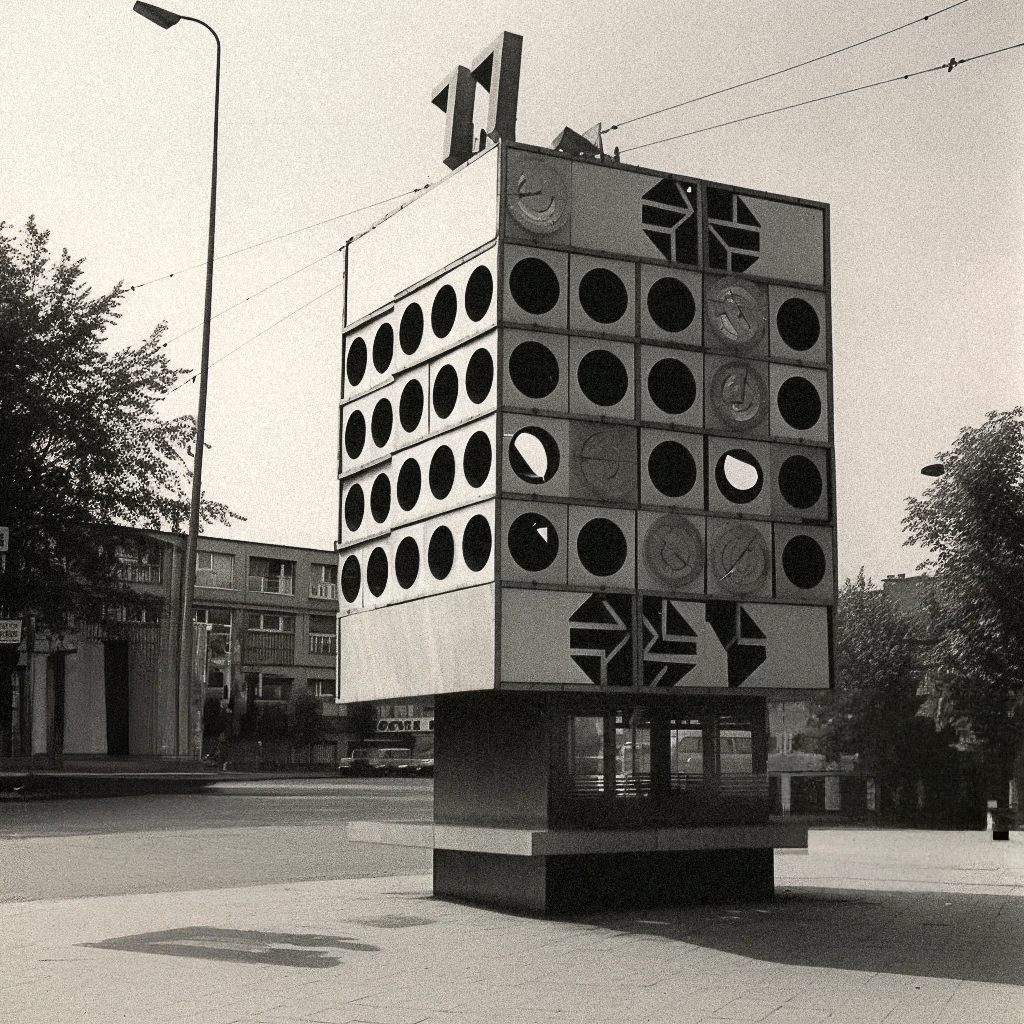
Even as critics continue to call for restrictions on Generative AI, it has already escaped containment, infiltrating the infrastructure of cultural and intellectual production. No longer confined to chatbots, image generators, demos, or laboratories, it has been integrated into Photoshop and Lightroom, Microsoft Word and Excel, and development environments like Visual Studio Code and Xcode. The familiar failures remain—hallucination, cliché, brittle reasoning, poor memory, the synthetic sheen that made early encounters easy to dismiss—especially for critics whose last serious engagement dates from the months after GPT-4’s release in 2023. But the AI they met then is not the one in front of us now: still erratic, still derivative, but already an everyday instrument of cultural and intellectual work. This is the awkward temporal problem AI presents to criticism. Its present failures may be passing defects, may continue to lessen over time, or may prove to be structural limits. AIs can now plan and execute complex tasks over minutes or even hours. Whether these capacities mark the emergence of consciousness and volition remains unresolved; what they already force is a belated revision of what those terms meant when we reserved them for ourselves.
In too much AI discourse, the future has become a screen—singularity and extinction, abundance and apocalypse—onto which the present is constantly displaced. This displacement is an alibi for not doing the harder work of understanding what AI already does. AI is already reorganizing cultural production, but its force for art is not merely instrumental; it is philosophical and historical. In the sequence that runs from photography through television to the network, each medium externalized some aspect of cultural production: perception, circulation, relation. With AI, the object is no longer the machine as such, but the return of cultural production to itself in alienated form.
The chapters that follow begin from this encounter.
“The Rise and Fall of the Author” begins with the panic over plagiarism in AI and traces the concept of authorship from classical rhetoric through Romantic genius to poststructuralist deconstruction, to reveal not a new threat but rather the persistence of the eighteenth-century legal and economic fiction of “original genius.”
“The Generative Turn“ inverts the dismissal of large language models as “stochastic parrots”—systems that merely predict and reproduce patterns without genuine understanding. This chapter explores how predictability is not a failure but a condition of human sociality itself. From ritual greetings to diplomatic protocols to artworks, culture operates through structured repetition that enables rather than constrains meaning.
“The New Surrealism“ reframes hallucination—those moments when pattern-matching produces impossible or counterfactual outputs—not as a flaw to be corrected but as a creative potential to be cultivated. Machine hallucination connects to the surrealist tradition of automatic writing and dream imagery, exploiting gaps in rational systematization to access what lies beyond conventional thought.
“Humanity and Its Double“ serves as the book’s conclusion, examining the uncanny anxiety that artificial intelligence provokes—the sense that these systems simulate consciousness without possessing it. Tracing this anxiety from Paleolithic cave painting through automata, photography, and phonography to contemporary AI, the essay argues that humanity’s persistent technological ambition has been animating matter and creating consciousness. AI’s uncanniness emerges not from failure but from success in revealing that consciousness itself might be more mechanical than our self-understanding allows.
Fredric Jameson, The Political Unconscious: Narrative as a Socially Symbolic Act (Ithaca: Cornell University Press, 1981). Jameson’s “political unconscious” names the systemic ideological constraints that structure cultural production below the threshold of individual awareness. The generative unconscious extends this into the technical domain: the statistical distributions of everything that has been made before, now made machine-readable. ↩︎
Hal Foster, The Return of the Real: The Avant-Garde at the End of the Century (Cambridge, MA: MIT Press, 1996), 15-32. The key introduction of deferred action is on 29. Foster’s position that the neo-avant-garde does not cancel the avant-garde is couched as an argument with Peter Bürger, 14. Walter Benjamin, The Arcades Project, trans. Howard Eiland and Kevin McLaughlin (Cambridge, MA: Harvard University Press, 1999). See especially Convolute N, “On the Theory of Knowledge, Theory of Progress.” ↩︎
N. Katherine Hayles, How We Became Posthuman: Virtual Bodies in Cybernetics, Literature, and Informatics (Chicago: University of Chicago Press, 1999), esp. 1–24, 50–83. Hayles traces how cybernetics severed information from material embodiment and made the flow of information through feedback loops central to the deconstruction of the liberal humanist subject. On the Macy Conferences, she argues that the cybernetic paradigm recast humans as information-processing entities essentially similar to intelligent machines (50–51). On the specifically French reception, see Céline Lafontaine, “The Cybernetic Matrix of ‘French Theory,’” Theory, Culture & Society 24, no. 5 (2007): 27–46, esp. 33–41, which argues that cybernetics was the unacknowledged infrastructure of poststructuralism—that Lacan, Lévi-Strauss, Foucault, Derrida, and Lyotard were already working within a cybernetic paradigm they neither named nor recognized. ↩︎
Jacques Derrida, “Différance” (1968), in Margins of Philosophy, trans. Alan Bass (Chicago: University of Chicago Press, 1982), 1–27. Derrida’s neologism captures both différer (to differ, spatially) and différer (to defer, temporally): meaning is constituted through a play of differences that never arrives at a present, self-identical signified. ↩︎
Roland Barthes, “The Death of the Author” (1967), in Image-Music-Text, trans. Stephen Heath (New York: Hill and Wang, 1977), 146, 148. ↩︎
Julia Kristeva, “Word, Dialogue and Novel” (1966), in Desire in Language: A Semiotic Approach to Literature and Art, trans. Thomas Gora, Alice Jardine, and Leon S. Roudiez (New York: Columbia University Press, 1980), 64–91. ↩︎
Jean-François Lyotard, The Postmodern Condition: A Report on Knowledge, trans. Geoff Bennington and Brian Massumi (Minneapolis: University of Minnesota Press, 1984). “Simplifying to the extreme, I define postmodern as incredulity toward metanarratives” (xxiv). ↩︎
Fredric Jameson, Postmodernism, or, The Cultural Logic of Late Capitalism (Durham: Duke University Press, 1991). Originally published as “Postmodernism, or, The Cultural Logic of Late Capitalism,” New Left Review I/146 (July–August 1984): 53–92. ↩︎
Foster, The Return of the Real, 32. Foster argues that postmodernist art and poststructuralist theory make their breaks through returns and that deferred action revises the notion of epistemological rupture: the discourses of postmodernity advance in a nachträglich relation to modernity rather than simply breaking with it. ↩︎
Fredric Jameson, “Postmodernism, or The Cultural Logic of Late Capitalism,” New Left Review I/146 (July–August 1984): 53–92, 78–79, https://doi.org/10.64590/s2p. Jameson argues there that representations of communicational and computer networks are not to be understood as technology determining culture, but as figures for the harder-to-represent totality of multinational capital. ↩︎
Kazys Varnelis, “The Rise of Network Culture,” in Networked Publics, ed. Kazys Varnelis (Cambridge, MA: MIT Press, 2008), 145–164. I use “networked publics” here in the sense developed in Networked Publics: publics constituted through networked circulation, open protocols, and distributed cultural production. This differs from later uses of the term that identify networked publics primarily with social media platforms. See also Bruce Sterling, “Atemporality for the Creative Artist,” keynote address, Transmediale 10, Berlin, February 6, 2010, published on Sterling’s Wired blog “Beyond the Beyond,” http://www.wired.com/beyond_the_beyond/2010/02/atemporality-for-the-creative-artist/. ↩︎
Kazys Varnelis, ed., Networked Publics (Cambridge, MA: MIT Press, 2008). On the digital, see Charlie Gere, Digital Culture, 2nd ed. (London: Reaktion Books, 2008). ↩︎
Albert-László Barabási and Réka Albert, “Emergence of Scaling in Random Networks,” Science 286, no. 5439 (1999): 509–512. Barabási and Albert demonstrated that real-world networks—including the World Wide Web—follow power-law degree distributions, with a small number of highly connected nodes emerging through preferential attachment. Clay Shirky confirmed the pattern in the blogosphere: of 433 blogs tracked through Technorati in January 2003, the top twelve (less than 3%) held 20% of all inbound links, and the top fifty held half. See Clay Shirky, “Power Laws, Weblogs, and Inequality” (2003), http://shirky.com/writings/powerlaw_weblog.html. ↩︎
Gilles Deleuze, “Postscript on the Societies of Control,” October 59 (Winter 1992): 3–7. Deleuze distinguished Foucault’s disciplinary societies—which operated through confinement (the factory, the school, the prison)—from emerging societies of control, which operate through continuous modulation: not confining subjects but adjusting their access, visibility, and movement through codes and protocols. Platform architectures are control in Deleuze’s precise sense: algorithmic feeds modulate what users see without their knowledge or consent, and the parameters can be adjusted at any moment. ↩︎
Oskar Negt and Alexander Kluge, Public Sphere and Experience: Toward an Analysis of the Bourgeois and Proletarian Public Sphere, trans. Peter Labanyi, Jamie Owen Daniel, and Assenka Oksiloff (Minneapolis: University of Minnesota Press, 1993). Negt and Kluge argued that the bourgeois public sphere’s claim to universal access was structurally contradicted by the exclusions on which it depended—a dynamic network culture reproduced at digital scale. ↩︎
Aaron Swartz, “Guerrilla Open Access Manifesto” (July 2008, Eremo, Italy), https://archive.org/details/GuerillaOpenAccessManifesto. Swartz was arrested in 2011 for downloading millions of articles from JSTOR via MIT’s network and died in January 2013 facing federal prosecution. ↩︎
On Meta’s use of shadow libraries, see Alex Reisner, “The Unbelievable Scale of AI’s Pirated-Books Problem,” The Atlantic, March 2025; on Nvidia, see heise online, “Nvidia: Court Documents Reveal Correspondence Regarding Pirated Dataset,” January 2025. On Anthropic, Judge William Alsup ruled in June 2025 that the company had downloaded over seven million pirated books from Library Genesis and the Pirate Library Mirror, holding that while AI training itself constituted fair use, building a “central library” of pirated copies did not. Anthropic agreed to a $1.5 billion class-action settlement, pending final approval. As of April 25, 2026, the official settlement site listed the claim, opt-out, objection, and re-inclusion deadlines as passed, with the Final Approval Hearing scheduled for May 14, 2026. See “Anthropic to Pay Authors $1.5B to Settle Lawsuit over Pirated Chatbot Training Material,” NPR, September 5, 2025; Bartz v. Anthropic Copyright Settlement, Key Dates, https://www.anthropiccopyrightsettlement.com/dates. ↩︎
Jean Baudrillard, The Illusion of the End, trans. Chris Turner (Stanford, CA: Stanford University Press, 1994), 9; Jean Baudrillard, “The End of the Millennium or the Countdown,” Economy and Society 26, no. 4 (1997): 447–455. ↩︎
Colin Rowe, The Architecture of Good Intentions: Towards a Possible Retrospect (London: Academy Editions, 1994), 30–43. Rowe’s “Eschatology” chapter traces the secularized millennial structure—crisis, conversion, redemption—through Le Corbusier, Wright, Banham, Giedion, and the standard historiography of the modern movement. Wright emerges as its most unabashed spokesman: “savior of the culture of modern American society; … savior now as for all civilizations heretofore” (37). Rowe recognized this structure as “common to all revivalistic practice,” producing what William James had called “tremendous emotional excitement” and “a complete division between the old life and the new” (The Varieties of Religious Experience [1902], quoted in Rowe, 38–39). On architecture as the ideology of the plan, see Manfredo Tafuri, “Toward a Critique of Architectural Ideology,” trans. Stephen Sartarelli, in Architecture Theory since 1968, ed. K. Michael Hays (Cambridge, MA: MIT Press, 1998), 2–35; originally published as “Per una critica dell’ideologia architettonica,” Contropiano: Materiali marxisti 1 (January–April 1969): 31–79. Tafuri argues that architecture’s ideology of the Plan is overtaken once the plan leaves utopia and becomes an operative mechanism of capitalist development. ↩︎
Hans Ibelings, Supermodernism: Architecture in the Age of Globalization (Rotterdam: NAi Publishers, 1998). ↩︎
Mark Fisher, Capitalist Realism: Is There No Alternative? (Winchester, UK: Zero Books, 2009), 2, 7–9. Fisher attributes the “end of the world” formulation to Fredric Jameson and Slavoj Žižek (2), then argues that capitalist realism names a later condition than postmodernism, in which alternatives to capitalism have become increasingly unimaginable and capitalism occupies the horizon of the thinkable (7–9). ↩︎
On the singularity as secularized eschatology, see Michael E. Zimmerman, “The Singularity: A Crucial Phase in Divine Self-Actualization?” Cosmos and History 4, no. 2 (2008): 347–370; and Ronald Cole-Turner, “The Singularity and the Rapture: Transhumanist and Popular Christian Views of the Future,” Zygon 47, no. 4 (2012): 777–796. Both trace the structural correspondence between singularity discourse and Christian millennialism. ↩︎
Dario Amodei, “Machines of Loving Grace: How AI Could Transform the World for the Better,” darioamodei.com, October 2024. The title alludes to Richard Brautigan’s 1967 poem “All Watched Over by Machines of Loving Grace,” itself a countercultural vision of cybernetic paradise. ↩︎
On p(doom) and expert estimates of AI extinction risk, see Katja Grace et al., “Thousands of AI Authors on the Future of AI,” arXiv:2401.02843, January 2024. One 2023 question asking about future AI advances causing human extinction or similarly permanent and severe disempowerment within the next 100 years produced a mean estimate of 14.4% and a median of 5%, while the authors emphasize that responses varied substantially with wording. On Amodei’s figure, see Jim VandeHei and Mike Allen, “Behind the Curtain: What if They’re Right?” Axios, June 16, 2025, and Megan Morrone, “Amodei on AI: ‘There’s a 25% Chance That Things Go Really, Really Badly,’” Axios, September 17, 2025. Geoffrey Hinton and Yoshua Bengio, both Turing Award laureates, have warned publicly since 2023 that the existential risk is real. ↩︎
Peter Sloterdijk, Critique of Cynical Reason, trans. Michael Eldred, Theory and History of Literature 40 (Minneapolis: University of Minnesota Press, 1987), xxxii–xxxvi, 3–7. Sloterdijk defines modern cynicism as “enlightened false consciousness” and argues that ideology critique is at a loss before a consciousness that has already learned its lessons but continues to function. The 2020s saw a striking development of this dynamic: a theory-literate cohort that has stopped diagnosing cynicism as a condition and begun occupying it as a position. The affect Sloterdijk identified as a fallen form of enlightenment has been reclaimed as a public style—knowingness without redemptive purpose, circulated across podcasts and online media adjacent to the accelerationist current around Nick Land, the post-liberal Catholic revival drawing on René Girard, and the intellectual circles around Peter Thiel. The phenomenon deserves separate treatment; what matters here is that the exhaustion of critique has not produced silence but a new affective economy, in which the performance of having seen through everything becomes itself the content. ↩︎
Recently, we spent a few days in Nikkō, in the mountains northwest of Tokyo. The town itself is known for the shrine of Tōshō-gū, where Tokugawa Ieyasu (1543–1616), the deified founder of the Edo shogunate, is enshrined. But the landscape was sacred long before its association with Tokugawa, shaped by centuries of mountain worship across its cedar forests, waterfalls, volcanic lakes, marshland, and the mass of Mt. Nantai itself. In the Meiji era, Nikkō became a destination for Westerners seeking its natural beauty. The British diplomat Ernest Satow published the first English guide in 1875 and built a summer villa at Lake Chūzenji above Nikkō. In Unbeaten Tracks in Japan (1880), Isabella Bird made a virtue of Nikkō’s long-standing pilgrimage character, presenting the difficulty of accessing the site and its remoteness as part of its appeal for Westerners. By the early twentieth century, the British, Italian, French, and Belgian embassies all maintained summer villas around the lake.
Lake Chūzenji, Nikkō
Since 1934, the area has been a national park, as impressive as any in the US. We stayed in Okunikko, “inner Nikkō,” on the shore of Lake Chūzenji under Mount Nantai, the sacred volcano whose eruption formed the lake by creating a volcanic dam and whose presence still anchors the region’s mountain worship. It was March, and the air was still cold, especially where the wind came off the water. Snow lingered in places. We saw wild snow monkeys in town, where signs warned tourists not to feed them; one sign explained the monkeys have learned that people carry food in plastic bags and will rip them out of your hands.
Yunoko Lake, Nikkō
On our second day, we took a bus to Yudaki Falls (“hot water waterfall”) and then climbed up to Yunoko Lake. Yunoko is a small volcanic lake, three kilometers around, formed when an eruption of Mt. Mitsudake, just to the east, dammed the Yugawa River. Hot springs feed it from below. The Yumoto Onsen, on the other side of the lake, has been in use for over a thousand years. The lake smelled strongly of sulfur. I found it hard to stay by the shore for long.
Concrete retaining wall, Nikkō
Along the road near the falls, a concrete retaining wall holds the volcanic hillside in place. This wall struck me because, however heavy-handed it is, the concrete lattice deforms to follow the topography of the rock face. My friend Gary Paige, who knows much more about Japan than I do, pointed me to the work of the photographer Toshio Shibata, who has produced some beautiful images of Japan’s erosion-control infrastructure.
Descending from the falls, we continued for about four miles through the forest and then out onto Senjōgahara marsh. Snow was just melting, and the trail through the forest was muddy and slippery until we reached the marsh and its boardwalk.
Japanese dwarf bamboo or Sasa nipponica, Nikkō
As we walked through the forest, I noticed that the ground was dense with dwarf bamboo (Sasa nipponica). I knew it was native, but something was off: the understory had the uniformity of a monoculture: the bamboo extended as far as the eye could see, and the forest canopy seemed more open than it should be. Signs (in English, no less) soon revealed a complicated ecological story. Sika deer (Cervus nippon) are native to Japan, but like white-tailed deer (Odocoileus virginianus) in the eastern United States, their numbers have surged to historic highs. The causes are the same: Japan’s licensed hunter corps fell from over five hundred thousand in the 1970s to under two hundred thousand by 2014, the farming population has dwindled over the same decades, and warming winters have thinned the snowpack, leading to fewer opportunities for starvation to cull the herd.1 More than that, after the extinction of the Honshū wolf in 1905, deer have had no predators in Japan save hunters. For centuries, the wolf had been a god in Japan, worshiped as Oguchi no Magami, the Large-Mouthed True God. Farmers petitioned it to keep boar and deer off their fields until fears of a rabies epidemic and rising encounters due to deforestation led to a bounty campaign by the Meiji state, modeled directly on efforts in the American West, and turned the sacred animal into vermin.2
The consequences of anthropogenic deer overpopulation in Japan are familiar to anyone who knows the northeastern United States; both areas now face a drastic decrease in the diversity of brush and understory plants, as well as a decline in the number of new trees. But the dwarf bamboo complicates the picture. Deer do browse it, but Sasa also benefits indirectly from deer damage to other species.3 Making matters worse, at Nikkō, a 900-hectare exclosure installed in 2001 has produced disappointing results. By the time of a 2022 study, freed of any deer browse, the bamboo inside the fence stood at about 60 cm tall, whereas the bamboo outside was only 15 to 18 cm tall. The study showed that vascular plant richness was roughly half that of the browsed plots outside, while tree regeneration remained scarce or absent.4 Excluding the deer did not restore the forest; it simply allowed one dominant species to consolidate its hold at the expense of others. No published case exists of a dense multi-decade Sasa monoculture successfully reversed to a diverse understory by any intervention; even clear-cutting combined with herbicide in a long-running Japanese experiment produced only partial, species-biased tree regeneration after three decades.
We are familiar with the concept of invasive species—our Cutleaf coneflower (Rudbeckia laciniata) can be as much of a problem in Japan as Japanese stiltgrass (Microstegium vimineum) can be for us—but the idea of native plants run amok due to anthropogenic disturbance is more unusual. The closest analogies are the way Hayscented fern (Sitobolium punctilobulum) inhabits forest clearings or Bracken fern (Pteridium aquilinum) colonizes woodland floors. In Great Britain, a subspecies of bracken, Pteridium aquilinum subsp. aquilinum, is both native to—again as the result of anthropogenic disturbance—considered a threat to biodiversity. Ironically, both ferns stubbornly refuse to establish themselves on my property. Ecologists have not yet settled on a term for this phenomenon; the closest is “native super-dominance”: the condition in which a species indigenous to a community comes to function like an invader because the regulatory structure that once limited its abundance has been dismantled.5
Japanese dwarf bamboo or Sasa nipponica, Nikkō
Homo sapiens is the super-dominant native species par excellence. We are part of these ecosystems, having been in the Japanese archipelago for at least 38,000 years and in the Northeastern United States since the retreat of the last glaciation. Humans have historically shaped the environment almost everywhere. Barring some islands, we are a native species—present for tens of thousands of years across Africa, Eurasia, Australia, and the Americas—and we have been driving megafauna to extinction for nearly as long. In Australia, giant wombats and marsupial lions vanished within a few thousand years of human arrival 46,000 years ago; in the Americas, mammoths and mastodons followed the same pattern 13,000 years ago. Paul Martin called this the overkill hypothesis: newly arriving humans encountered animals naïve to predation with weapons, and the easily obtained calories drove our rapid colonization of frontier landscapes. Africa was the sole exception: more of its megafauna survived because the animals there co-evolved with humans and learned to be wary of us early on.
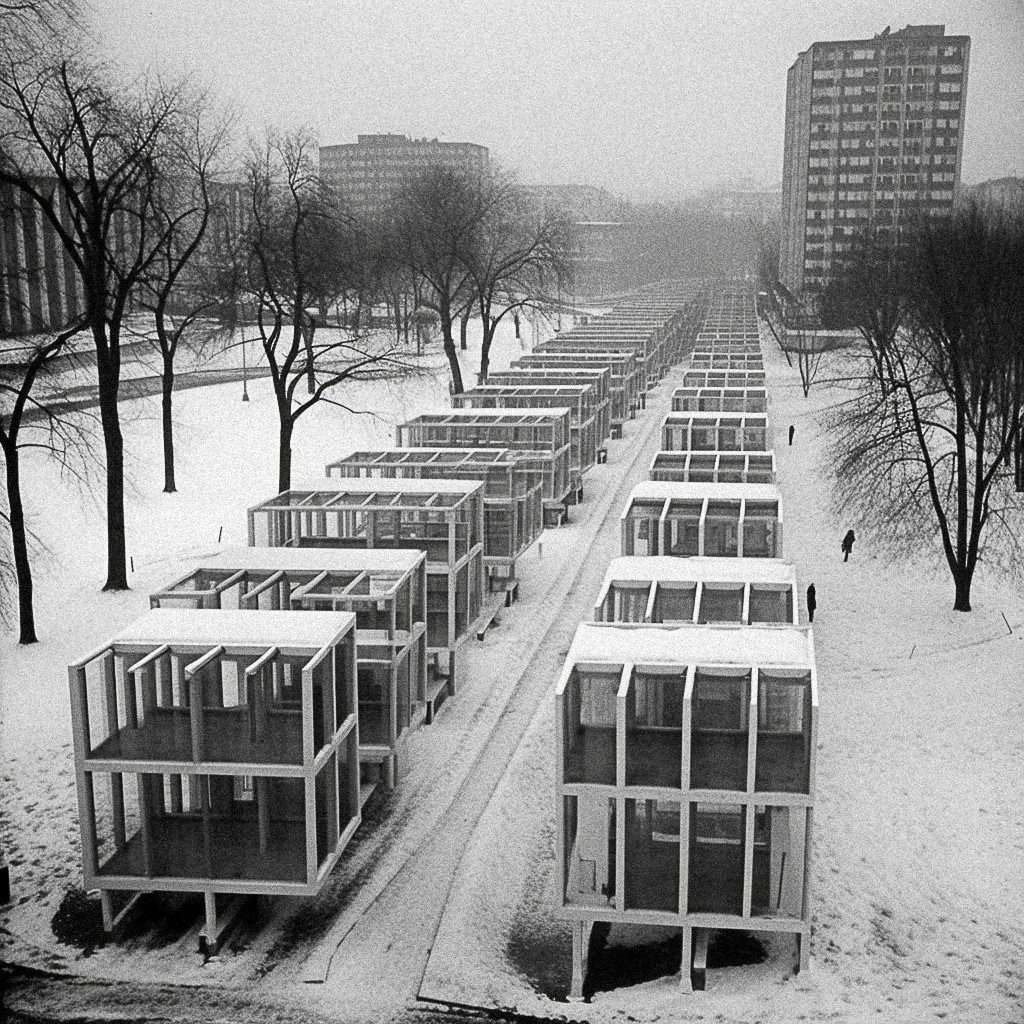
After the extinctions, ecosystems found new equilibria—ones that included human hunters as a regulatory force alongside wolves and other predators. For millennia, the system held, with farmers killing deer that threatened their crops while wolves took more, the redundancy of multiple predators kept prey populations below the threshold at which they could overwhelm the vegetation. Industrialization, population growth, and intensive livestock farming dismantled this arrangement: we exterminated the carnivores wherever possible, then left the land ourselves as the farm population collapsed, hunters aged out without replacement, and farmland became housing. We have become a super-dominant native species, and our withdrawal from predation, combined with our extermination of competing predators, has made deer super-dominant alongside us.
Still more Japanese dwarf bamboo or Sasa nipponica, Nikkō
Below the forest, we paused at Izumiyadoike Pond and cleaned off our shoes, which were covered in mud from the forest trail. On the flatter boardwalk of Senjōgahara marsh ahead, it was much easier going. Senjōgahara is one of the largest highland marshes on Honshū. Natural history claims it is the product of volcanism. Roughly seventeen thousand years ago, an eruption of Mt. Nantai laid down a massive pyroclastic flow—the Ryūzu Falls pumice-flow deposit—that dammed the Yukawa valley, creating a lake. A later lava flow, around fourteen thousand years ago, created the separate dam that formed Lake Chūzenji downstream. The upper lake gradually filled with sediment and became marsh. The cold weather on the site slowed the decay of plant matter, leading to a peat-forming wetland, which I am told is called a “high moor.”
Senjōgahara, Nikkō
But there is another account. Senjōgahara means “Battlefield Plain.” According to the local legend, it takes that name from a war between the deity of Mt. Nantai and the deity of the more distant Mt. Akagi over Lake Chūzenji in which Nantai became a great serpent and Akagi a giant centipede.6 The serpent’s champion, an archer named Sarumaru, shot the centipede through the eye; its blood stained the nearby marsh, which became Akanuma—Red Swamp. In this telling, the conflict is not an event that happened on the land so much as one that made it: the lava flow is the serpent’s movement, the ash cloud the centipede’s thrashing. Near the end of the trail, a creek runs red—iron in the water, or the centipede’s blood.
Iron stains a creek red, Senjōgahara, Nikkō
It’s hard not to read our own ecological battle into this myth. No surprise, this area is also threatened by anthropogenic factors. Deer had punched holes four to ten centimeters across through the Sphagnum mats, baring the peat beneath and collapsing the wildflower communities that depended on them. Seventeen kilometers of deer-exclusion fencing had to be built around the marsh in 2001. Invasive species are also a threat: Ministry of the Environment crews pull cutleaf coneflower (Rudbeckia laciniata) by hand from Senjōgahara every summer.7 But, tempting though it is, I am not sure how useful it is to draw the analogy with the mythological battle.
While walking through Senjōgahara, I thought it might be more useful to think about how Japanese mountain worship traditions treat the land. In the American imagination, land is mostly either wilderness—to be protected from people—or scenery—to be improved for them. Both treat land as object, with humans outside. Even our idea of anthropogenic change, which I have repeatedly deployed in this essay, seems to portray humans as latecomers to long-established ecologies. But at Senjōgahara, the signs told us, the sacred landscape is made by gods who don’t just dwell on mountains, they are mountains. Humans, like the archer Sarumaru, are not latecomers but rather participants in the battles. Wolves are also gods, with Oguchi no Magami being petitioned by farmers to keep deer off fields.
In mountain worship, kami are not spirits that inhabit landscape features—they are the features: a waterfall is a god and a mountain is a god. But humans are not a separate creation either, rather they are late-arriving kin, descended from kami, capable of becoming kami themselves after death. Ancestors become kami; emperors—until the end of the War—are living kami. The framework does not recognize nature, humanity, or culture as separate categories.
But there’s a complication. Shintō is in many ways constructed. Fabio Rambelli argues that the idea of the Japanese love of nature is largely a Meiji-era conflation of nativist scholarship and Western Orientalism; the word shizen (nature) is itself a Meiji neologism, coined to translate the Western concept. In contrast, he claims, in medieval Buddhist doctrines, sacred trees were not ecological but institutional—tools to justify temple control over forests. The same is true of my own country and Lithuanian pagan traditions: Francis Young shows that much of what we think we know about Perkūnas and the Baltic gods was assembled by sixteenth-century antiquarians and nineteenth-century nationalists, who created mirages through transcription errors and reliance on Indo-European comparative linguistics. We continue to assemble the religion today through the religion of Romuva.8
Still, this does not entirely invalidate the framework. All ways of seeing landscape are historical constructions; wilderness itself is a nineteenth-century invention, a legal and cultural fiction that justified the frontier by declaring inhabited land empty. The question is what a framework helps us perceive. The wilderness/scenery binary treats humans as external to nature—either protecting it from afar or consuming it as view. The kami model, however modern its current form, at least poses the question differently: humans as participants in a continuum, capable of damaging but also of belonging. For thinking about the withdrawal of human predation, about our strange position as a native species that has removed itself from the predator function, that reframing may be more useful than treating ourselves as outside forces acting upon nature.
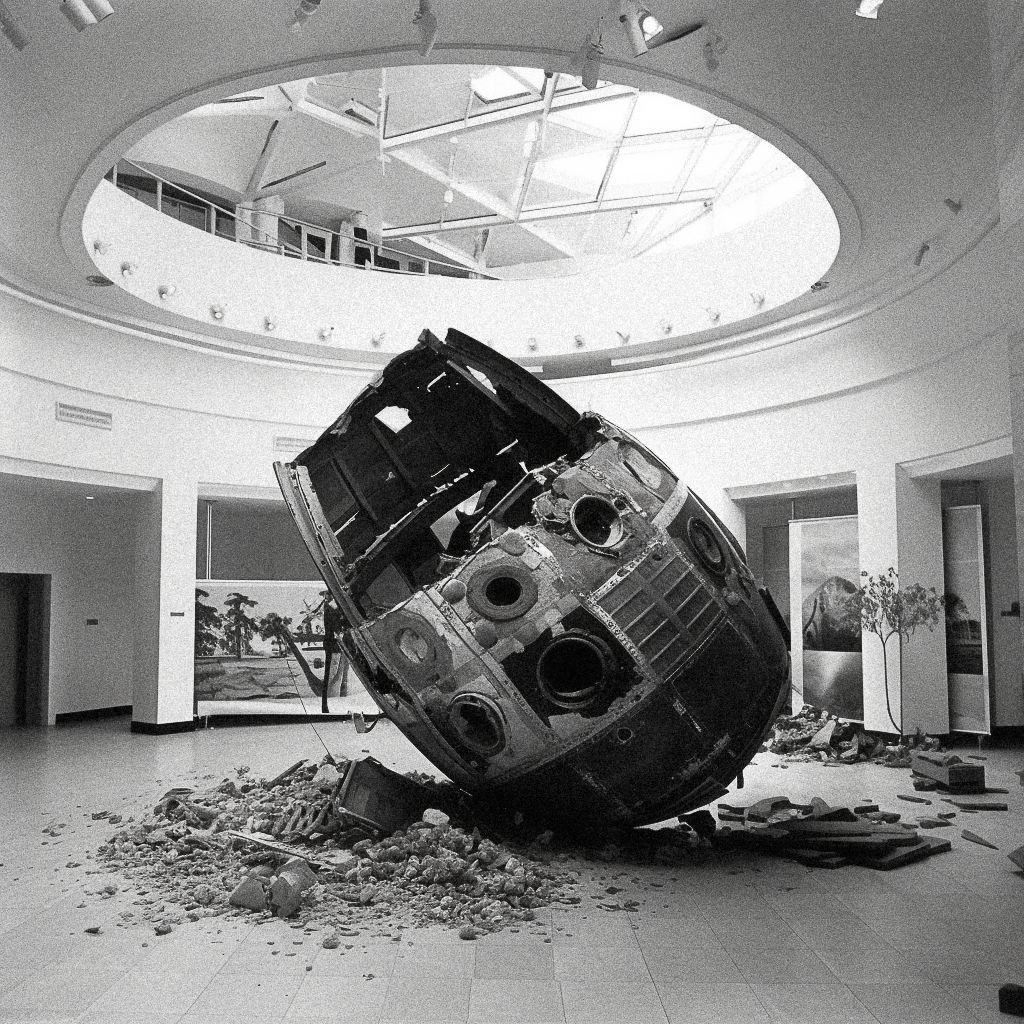
The archaeologist Mark Edmonds makes a similar point about Neolithic monuments in Britain. We assemble the past, he writes, in a world shaped by very different values and desires, and these in turn shape the pasts that we write.9 No landscape sits out there waiting to be exploited. Landscapes are subjective, understood as much by ways of acting as by ways of seeing. The professional archaeologist and the modern pagan are both constructing pasts through their present concerns. This does not make either framework false—it makes both of them historical, which is to say, human.
Perhaps invented traditions are even more appropriate for our time than inherited ones. The frameworks we construct now are built for our present needs rather than received from contexts that no longer apply. In my recent essay on the Zen garden, I argued the dry garden was not really Zen at all—that building one in New Jersey was kitsch. I still think so, but the reason sits differently now. A Zen garden imported as a set piece, raked and viewed from a veranda, encodes exactly the separation Zen doctrine refuses. If one is to deny the self, one needs to deny the separation from the surrounding world. The question is not whether to abandon the Zen garden but how one would invent it now. A Zen garden for our time could not be a composition to contemplate. It would have to be an engagement—planting, weeding, succession, decay—with the human inside the garden rather than on the veranda, sipping a gin and tonic.
As for Senjōgahara, to me, the Battlefield Plain’s lesson was that we have lost our way in the world. We have forgotten that we are not outside of nature, we are within it. The town of Montclair, for its part, just passed an ordinance declaring that deer hunting is illegal on township land. There hasn’t been a deer cull in the area in the entire time I have lived in town, but if a bear is sighted, it is killed straightaway by the police, and residents breathe a sigh of relief on Facebook. One animal has been deemed innocent, another has been deemed dangerous. Until we construct better myths for our relationship to the world than Disney’s Bambi, life here will be out of balance.
1 Hayato Iijima, Junco Nagata, Ayako Izuno, Kentaro Uchiyama, Nobuhiro Akashi, Daisuke Fujiki, and Takeo Kuriyama, “Current sika deer effective population size is near to reaching its historically highest level in the Japanese archipelago by release from hunting rather than climate change and top predator extinction,” The Holocene 33, no. 6 (2023): 718–729, https://doi.org/10.1177/09596836231157063. On the quantitative land-use and snow-cover attribution, Haruka Ohashi, Yuji Kominami, Motoki Higa, Dai Koide, et al., “Land abandonment and changes in snow cover period accelerate range expansions of sika deer,” Ecology and Evolution 6, no. 21 (2016): 7763–7775, https://doi.org/10.1002/ece3.2514. ↩
2 Brett L. Walker, The Lost Wolves of Japan (Seattle: University of Washington Press, 2008). ↩
3 Masaki Ando, Akemi Itaya, Shin-ichi Yamamoto, and Eiji Shibata, “Expansion of dwarf bamboo, Sasa nipponica, grassland under feeding pressure of sika deer, Cervus nippon, on subalpine coniferous forest in central Japan,” Journal of Forest Research 11, no. 1 (2006): 51–55, https://doi.org/10.1007/s10310-005-0180-9. ↩
4 Lisa Petersson, Carl Salk, Daniel Jensen, Göran Thor, and Tatsuhiro Ohkubo, “Long-Term Deer Exclusion Releases Dwarf Bamboo, Reducing Vascular Plant Diversity,” Applied Vegetation Science 28 (2025): e70018, https://doi.org/10.1111/avsc.70018. The Nikkō result is consistent with the broader Japanese record that even aggressive intervention reverses Sasa only partially. See T. Masaki, N. Tanaka, T. Yagihashi, M. Ogawa, H. Tanaka, H. Sugita, T. Sato, and T. Nagaike, “Dynamics of dwarf bamboo populations and tree regeneration over 40 years in a clear-cut beech forest: effects of advance weeding and herbicide application,” Journal of Forest Research 26, no. 2 (2021): 138–147, https://doi.org/10.1080/13416979.2020.1847376. ↩
5 Vânia Regina Pivello, Marcus Vinicius Vieira, Maria Tereza Grombone-Guaratini, and Dalva Maria Silva Matos, “Thinking about Super-Dominant Populations of Native Species—Examples from Brazil,” Perspectives in Ecology and Conservation 16, no. 2 (2018): 74–82, https://doi.org/10.1016/j.pecon.2018.04.001. For a northeastern U.S. analogue, see Songlin Fei, Peter Gould, Melanie Kaeser, and Kim Steiner, “Distribution and Dynamics of the Invasive Native Hay-Scented Fern,” Weed Science 58, no. 3 (2010): 408–412. For the two-decade argument over whether a native species can be “invasive,” see Mark A. Davis et al., “Don’t Judge Species on Their Origins,” Nature 474 (2011): 153–54, https://doi.org/10.1038/474153a; Daniel Simberloff et al., “The Natives Are Restless, But Not Often and Mostly When Disturbed,” Ecology 93, no. 3 (2012): 598–607, https://doi.org/10.1890/11-1232.1; and Heidi A. Nackley et al., “The Nebulous Ecology of Native Invasions,” Trends in Ecology & Evolution 32, no. 11 (2017): 814–24, https://doi.org/10.1016/j.tree.2017.08.003. ↩
8 Fabio Rambelli, Vegetal Buddhas: Ideological Effects of Japanese Buddhist Doctrines on the Salvation of Inanimate Beings (Kyoto: Italian School of East Asian Studies, 2001), 72–73; Francis Young, The Silence of the Gods: The Question of Baltic Paganism in Reformation-Era Prussia and Lithuania (Woodbridge: Boydell Press, 2024), 48–50. ↩
9 Mark Edmonds, Ancestral Geographies of the Neolithic: Landscape, Monuments and Memory (London: Routledge, 1999), 9–10. ↩
kazys varnelis (contact), ph.d. conducts transdisciplinary research and practice. trained as an architecture historian, he is also an artist, curator, and designer exploring the impact of technology. recently, he has been involved with gardening design with native plants.